
 2 months ago
68
2 months ago
68
ADVERTISE HERE
 A boat obstructed by teparok debris along Sungai Batang Oya, Dalat.
Advertisement

By Yvonne T
Along the banks of Sungai Oya in Dalat, Mukah, thick mats of water hyacinth, or ‘teparok’ as the Melanau call it, cling to the river’s edge, beneath stilts of famed traditional Melanau river houses.
To an outsider, a sea of hyacinths is a vision of beauty, its blooms curving outwards from the water in vibrant hues. Yet few understand the struggles of the villagers living alongside them, choked and bothered by these aquatic blooms that snag floating debris, block narrow stretches of the river, and give cover to hidden dangers near the banks. What an outside eye perceives as natural beauty has long been a hindrance to the locals.
Advertisement

As a patch of teparok floats by, 53-year-old Nurkhaleda Abdullah from Kampung Kekan, one of many villages along Sungai Batang Oya that rely on the river to commute, gently steers her narrow longboat around it.
 A patch of teparok seen floating along Sungai Batang Oya, Dalat.
This is a common sight along Sungai Batang Oya. But in 2020, as the Covid-19 lockdown brought activities to a standstill, these teparok thrived, choking the river and pushing the call for a solution.
“It’s a lot less now, compared to before when it was so difficult to drive the boat,” Nurkhaleda explained over the steady hum of the engine.
“Before this, we usually clear these (teparok) up ourselves or there will be people who will remove it and dump it on land. Now, at least we can get some income from this,” she added.
“During Covid (lockdown), when we couldn’t go out, the river was covered in them,” 72-year-old Bedah Pak, also from Kampung Kekan, shared.
Right until finally, when people learnt how to make money out of the nuisance, the teparok started to bloom in a different light.
“Now, we’ve cleared a lot of it and we’re collecting them until we have enough to sell it to the farm,” she added, indicating a small collection she had purposely gathered under the stilts of her house perched along the river.
 Bedah Pak harvesting teparok near her house along Sungai Batang Oya, Dalat.
Behind this transformation is the ‘Organic Fertiliser Processing and Black Soldier Fly (BSF) Breeding Farm’ in Dalat, established under the ‘From Waste to Wealth’ initiative; set to be gamechanger not only for the river ecosystem in Dalat, but for its people.
Sustainable solution
The integrated facility breathes new life into organic waste, transforming it into valuable assets through BSF technology. The pervasive teparok now serves as a primary feedstock. Alongside food waste gathered from schools and restaurants, and the residues from sago processing, these materials are consumed by BSF. The result is a double victory: organic fertiliser and protein-rich animal feed, supporting a circular economy that benefits both the environment and local livelihoods.
For Dalat, however, the most significant impact lies in conquering the green chokehold that has plagued Sungai Batang Oya for decades.
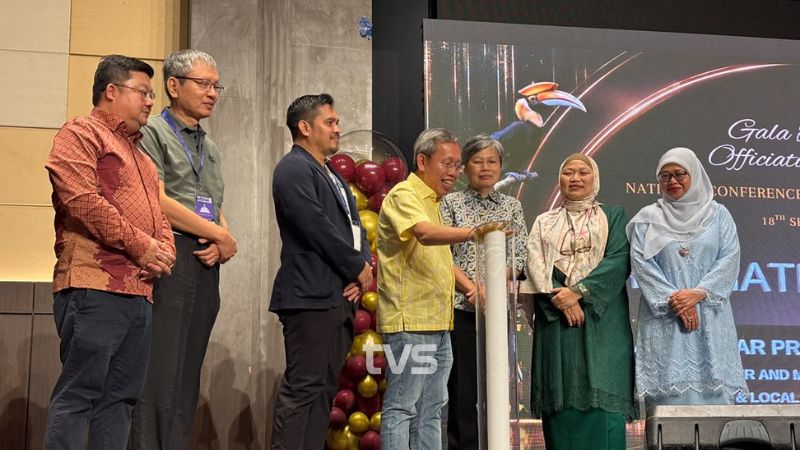
 Fatimah (fourth right) officiating the launch of the Organic Fertiliser Processing and Black Soldier Fly (BSF) Breeding Farm in Dalat.
At the end of 2020, the Sarawak government launched a massive river-clearing operation to liberate the suffocating waters of Sungai Batang Oya. The exercise saw 3,854 tonnes of teparok cleared. But while the river was mostly cleared, the fast-growing and invasive water hyacinth remains a problem that requires a sustainable solution.
Seeking an alternative approach, Dalat assemblywoman Dato Sri Fatimah Abdullah engaged AD Leong Bon Huat, director of Ex-Community Group, who had already been operating a BSF technology facility in Bintulu. Together with Koperasi Dalat Lestari Bhd (Koperasi Dalat Lestari), they proposed an innovative idea: instead of treating teparok as an endless waste problem, why not use it as a valuable raw material to power a BSF-based processing system?
The project found its catalyst in 2023, officially kicking off with a RM2.253 million contribution from PETRONAS through its corporate responsibility programme.
Uplifting the community
Today, this processing centre stands as a beacon of opportunities for communities living along Sungai Batang Oya, Dalat, particularly for the women and housewives seeking additional incomes close to home.
Although the facility employs only three full-time assistants, its true workforce extends far beyond its walls. The project thrives on the collective effort of the villagers who harvest teparok from the river.
To encourage participation, Koperasi Dalat Lestari purchases the gathered teparok at RM0.40 per kilogramme.
 Muhammad Aznie prepares teparok for shredding before it undergoes fermentation.
For residents like Nurkhaleda Abdullah and Bedah Pak, the initiative has turned routine river clearing into a rewarding activity, bringing in an estimated additional income of up to RM400 a month from selling the gathered teparok.
For others, the project has opened the door to employment.
Rina Asin, who works at the facility, also from Kampung Kekan, was a full-time housewife before working at the facility after attending a three-day course on the processes at the facility.
Beyond the benefit of a steady income Rina viewed the processing centre from the lens of making the river safer.
 Rina working at the BSF biopond at the Organic Fertiliser Processing and BSF Breeding Farm, Dalat.
“These teparok can be dangerous, especially when there are so many of them,” she said.
“Crocodiles can hide beneath them because the plants grow along the riverbanks. When the growth becomes too dense, boats can get trapped, and they can even interfere with the construction of bridges.”
For communities whose entire lives revolve around the water, clearing this invasive weed is about far more than just improving the view. It means safer daily journeys, smoother transportation, and secure connectivity for the villages that depend on the waterway to survive.
A concerted effort
The success of the “From Waste to Wealth” initiative has been built on more than just clever technology; it is the fruit of a successful collaboration spanning the State government, private sectors, cooperatives, and the local community itself.
To give the processing centre the best possible room to grow, the company owning the land granted Koperasi Dalat Lestari a rental rate of just RM1 per month for five years for the project. PETRONAS’ funds have also been channelled providing equipment, hands-on training, and vital resources for the facility. By keeping overheads relatively low, with transportation and staff wages accounting for the primary expenses, the facility can focus its resources entirely on scaling up production and refining its operations.
Today, the centre produces between 300 and 500 kilogrammes of organic fertiliser each month and according to Koperasi Lestari Dalat chairman Muhammad Aznie Abdullah, demand has been steadily growing, driven by positive feedback from users who value the products’ fully organic production process, free from chemical additives.
 Muhammad Aznie holding probiotic fertilizers made with BSF.
True to the principles of a circular economy, the facility ensures nothing goes to waste. Every scrap of organic material, from teparok and food waste to oil palm biomass and sago residues – feeds the BSF breeding system, completing a closed-loop system where every single input serves a distinct purpose.
“So far, the response from the centre has been positive, especially from the communities here,” Muhammad Aznie shared.
The encouraging reception is reflected in the facility’s growing sales. In 2025, it sold 804 kilogrammes of organic fertiliser and animal feed, generating RM2,400 in revenue. As of May 2026, sales had already reached 676 kilogrammes, contributing RM2,119 in income.
A reformation
On the other side of the project, this sustainable technology is transforming more than just communities in Dalat. For AD Leong, the man who introduced BSF technology to the community in Dalat and trained locals to operate the facility, the project is a chapter in a life fundamentally ‘renewed’.
Years ago, a mistake led him to prison on death row. His sentence was later commuted to life imprisonment, and after serving his time, he emerged determined to rebuild his existence with purpose. He adopted the moniker ‘AD’, short for ‘After Death’, a reflection of what he described as his new beginning.
 AD Leong speaks to members of the media.
Together with his business partner, known simply as Fong, he founded the Ex-Community Group, a technology transfer consultancy dedicated to sharing sustainable practices with communities. Over the past seven years, BSF technology has become the core of their expertise.
The company’s mission extends beyond environmental sustainability. True to its name, it offers former inmates a pathway back into society by equipping them with skills in BSF farming, carpentry, and landscaping, granting them the same opportunity to rebuild their lives from scratch.
For AD Leong, the Dalat project represents the perfect intersection of environmental progress and social rehabilitation.
“We started Ex-Community Group as a technology transfer consultancy, where we teach and guide communities on sustainable technologies,” he said.
“For the Dalat project, we spent three years learning and experimenting with how to use water hyacinth in the BSF process. Today, seeing the farm operating successfully makes me proud, and I hope it continues to receive the support it needs to grow.”
Since the facility began operating, interest surrounding the technology has steadily mounted.
“We’ve had more people approaching us to learn about BSF technology,” he said. “We’re always willing to teach and guide them.”
Hopes for the future
Optimism ripples through the very communities the centre serves. For Bedah Pak and Nurkhaleda, their hope is that the facility will scale up, allowing more people to discover the benefits of BSF-derived products while driving up demand for the teparok collected by the villagers.
 Bedah Pak (left) and Nurkhaleda speaking to members of the media at the Organic Fertiliser Processing and BSF Breeding Farm in Dalat.
An expanded facility would also mean greater processing capacity, enabling more teparok to be removed from Sungai Batang Oya while creating additional income opportunities for riverside communities.
Muhammad Aznie shares the same ambition. He hoped to increase the centre’s production to at least five tonnes of organic fertiliser per month, with plans to expand their market footprint far beyond Dalat’s borders.
The road ahead
For PETRONAS, the project demonstrates how environmental challenges can become opportunities when communities, government and industry work together.
PETRONAS Sarawak general manager, Norazibah Md Rabu said the initiative reflects the company’s purpose of enriching lives for a sustainable future by empowering communities to embrace circular economy solutions.
“The organic fertiliser processing project is in line with our statement of purpose, where our aspiration is to empower the local community in supporting the sustainability agenda and the circular economy in addressing problems or issues faced by communities, especially those faced by rural communities,” she said.
 Rina (left) and Norazibah holding BSF larvae at the Organic Fertiliser Processing and BSF Breeding Farm’ in Dalat.
She added that the initiative also aligns with the Sarawak Government’s Post Covid-19 Development Strategy 2030, which envisions a high income, inclusive and sustainable economy.
Looking ahead, Norazibah hoped the project would serve as a model for other communities across Sarawak.
“When communities are empowered to solve their own challenges, and with direct involvement from the community, for us, that is one of the key success factors.
“We also hope through this project, it would encourage communities, not just in Dalat, but other places, that they can work together with companies like PETRONAS, to make something that brings positive impact to Sarawak,” she added.
The successful launch of this project also proves that when communities are given access to technology, training and continuous support, they are able to become agents of change that bring benefits to their respective areas. – DayakDaily



 English (US) ·