
 3 weeks ago
36
3 weeks ago
36
ADVERTISE HERE
Political parties have come to accept an unsettling aspect of the new political DNA: form a coalition, contest separately in elections, see the outcome, and if needed form a new coalition – even with rivals.

We often say that politicians are liars or that they cannot be trusted; that they are only interested in power, not the voter. The fact is, in recent years especially, they have been brutally honest about their intentions.
It is our fault for refusing to recognise it and continuing to blame them, for politics has never been as transparent as it is now.
Take Johor. Barisan Nasional (BN) and its lynchpin Umno remain part of the federal unity government alongside Pakatan Harapan (PH), yet in the upcoming Johor state election on July 11, BN and PH are contesting all 56 seats head-to-head.

BN is campaigning directly against PH’s component parties—DAP, PKR and Amanah.
The main opposition coalition Perikatan Nasional (PN) is similarly divided: PAS is fielding candidates in 11 seats, while Bersatu contests 16 but the two parties are not coordinating efforts.
PAS has instructed its members and supporters to vote for BN candidates in non-PN seats but has remained silent on support for Bersatu candidates. Bersatu has issued no such directive but some of its members have said they would vote for PH candidates.
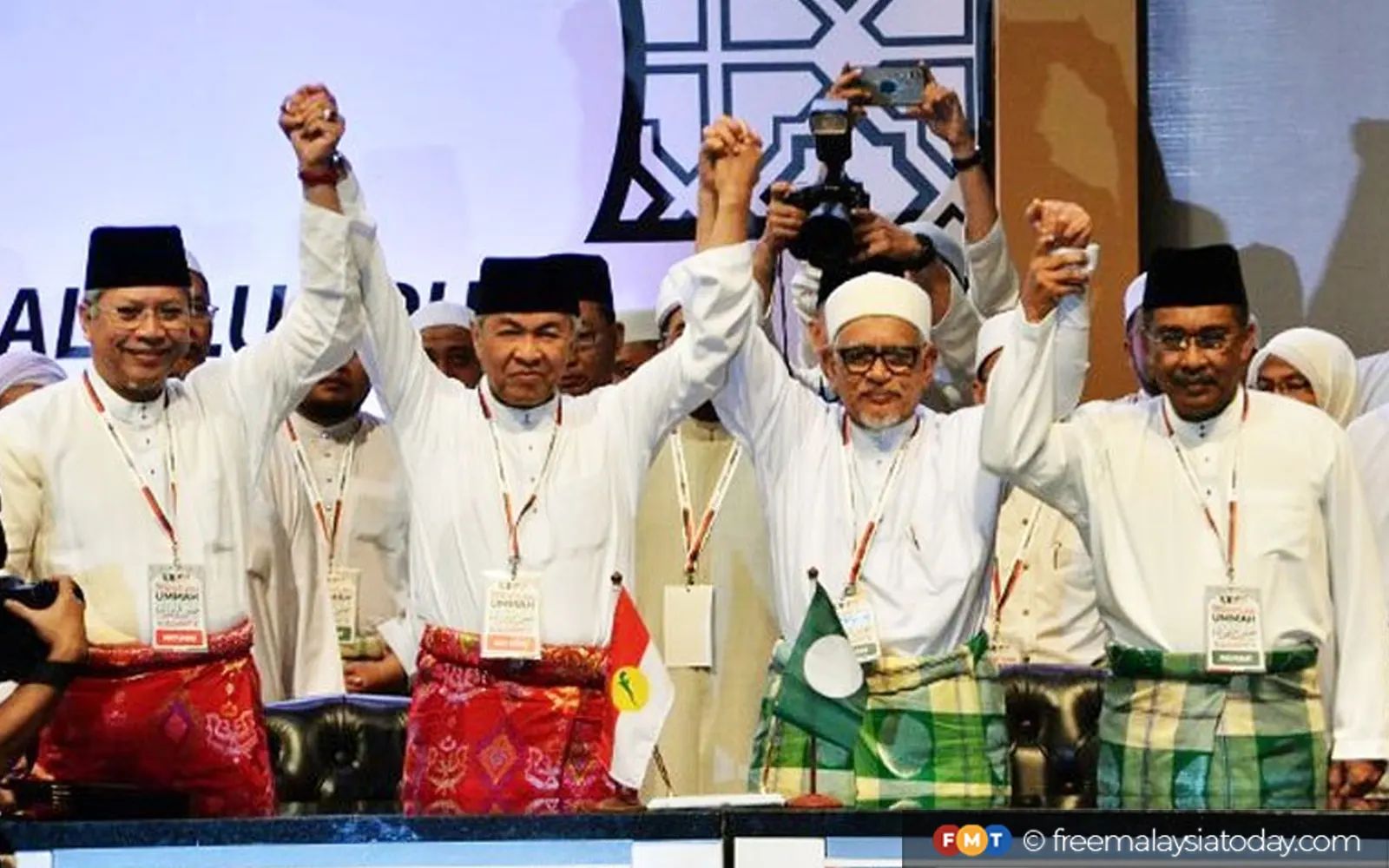
Negeri Sembilan is shaping up to be another such battlefield.
However, this is not entirely new. Sarawak has long set the pattern: Gabungan Parti Sarawak (GPS) governs at state level while supporting the federal government, yet treats PH as a local rival. In Sabah, Warisan (aligned with PH federally) has also clashed with BN and others at the state polls.
We have a situation where the coalition and the competition are the same people.
In Putrajaya, they sit together in Cabinet, smiling for the cameras, pledging unity for the nation. But once the campaign trail begins in Johor, Negeri Sembilan, or Sarawak, those same allies transform into rivals, trading barbs and battling for every seat.
For instance, on July 4, former Umno Youth chief Khairy Jamaluddin accused PH of copying BN’s manifesto for the Johor state election. In rejecting the accusation, PH election machinery director Amirudin Shari said: “They can say whatever they like, but the data and the facts clearly show these are original ideas generated and developed by PH’s leadership over several months.”
As voters, we know that political parties and politicians seek power. We accept this fundamental reality because we feel, or at least hope, that their craving for power will meet our expectations of good and fair governance midway, resulting in a win-win situation.
We also recognise that politicians are opportunists, shifting alliances for career advancement or perks.
But in Malaysia today, opportunism has become structural, constant, and identity driven. And of late, Malaysia’s coalition politics is being shaped by tactical alliances that prioritise electoral survival over coherent governance.
Several factors have intensified it. The collapse of BN’s two-thirds majority under Dr Mahathir Mohamad (1981–2003), which muted contradictions, is a major factor. After 2008, opposition coalitions gained several state governments, and the system fragmented into various coalitions such as PH, BN, PN, GPS, and GRS.
Another reason is that parties in Sabah and Sarawak have asserted greater independence, with regional priorities amplifying local rivalries, especially since 2018.
Malaysia also lacks robust federal-state negotiation mechanisms, leaving a vacuum that tactical opportunism fills.
Although voters expect opportunism, its frequency and visibility erode confidence in political parties, politicians and politics itself. Cynicism deepens as parties appear interchangeable, driven only by survival. This results in lower voter turnouts, which is bad for a democracy.
As opportunism produces governments cobbled together from rivals, government policies may lack coherence and reform agendas – as we have seen – stall.
Intense opportunism, as we are seeing, often exploits ethnic and religious divides. Identity-based campaigning can sharpen ethnic and religious divides, undermining national unity.
On July 1, Amanah deputy president Mujahid Yusof Rawa warned that political opponents were deliberately exploiting race and religion to incite hatred ahead of the Johor polls, particularly by portraying DAP as the main threat to Malays.
Frequent realignments also destabilise institutions such as the civil service, Parliament, and state assemblies. Populist economics—subsidies and handouts—can undermine fiscal discipline, while long-term reforms in education, healthcare, and governance are often sacrificed for short-term survival.
Yet there are positive effects too. Voters can differentiate between federal and state priorities, rewarding or punishing coalitions based on performance. State-level competition prevents any single bloc from dominating, encouraging accountability and innovation while amplifying regional voices.
Intra-coalition rivalry means Malaysians are unlikely to see another overbearing coalition or party dominating everything, as Umno did under Mahathir.
Overall, though, Malaysia’s identity politics and opportunism have combined to make politics unsavoury in the eyes of the public. For, Malaysia’s political DNA has shifted from service to the people to survival first, service later.
Umno, for instance, must constantly prove its dominance among Malay voters, even if that means attacking federal partners or going solo, with a pinch of BN representation, in Johor. DAP must defend its urban base, even if it means clashing with GPS in Sarawak or MCA in Johor. GPS and GRS must assert autonomy, even if it strains federal unity.
As parties cannot afford to concede ground—every seat is a lifeline—they conclude that it is better to fight their friends today than risk irrelevance tomorrow.
This “friends at federal, foes at state” arrangement is not based on ideology; it’s not vision either; and it’s more than the survival instinct – it’s the desire to rule the roost.
It’s evident in Johor, and will soon be in Negeri Sembilan when that state goes to the polls on Aug 1. And everyone knows – although no one says it openly – that Johor serves as a trial run for Umno. If it wins big in Johor and does well in Negeri Sembilan, Umno will go solo in the next general election.
That would mean PH and BN likely contesting all parliamentary seats. That would mean PAS and Bersatu likely contesting against each other. That would mean a noisy campaign and a realignment of parties when the results are known.
Political parties and politicians have come to accept another aspect – a rather unsettling one at that – of the new political DNA: form a coalition, contest separately in elections, see the outcome, and if needed form a new coalition – even with rivals.
They are leaving open the question of who will be in the coalition that governs, unlike in the past when they decided who they wanted to work with before entering the contest.
Through their actions, parties and politicians are declaring that power takes priority. And they are not trying to hide it.
The views expressed are those of the writer and do not necessarily reflect those of FMT.
Stay current - Follow FMT on WhatsApp, Google news and Telegram
Subscribe to our newsletter and get news delivered to your mailbox.


 English (US) ·