


 3 months ago
169
3 months ago
169
ADVERTISE HERE
JAKARTA: Indonesia’s latest moves to steady the rupiah and calm the stock market may have helped arrest the immediate slide, but experts say the bigger issue is a lack of investor trust.
After the rupiah hit an all-time low on Monday (Jun 8), trading at 18,168 rupiah per US dollar, the central bank intervened quickly by raising interest rates by 25 basis points on Tuesday in an unexpected off-cycle rate hike, taking the benchmark rate to 5.5 per cent.
Bank Indonesia said that the rate hike was necessary because "the rupiah exchange rate has weakened more than expected" since its last meeting at the end of May.
Last Saturday, the government also agreed to increase yields on Indonesian assets to attract portfolio inflows and support the rupiah, although details remain scarce.
Economists told CNA these steps are unlikely to restore long-term confidence unless the government addresses deeper concerns over fiscal credibility, policy predictability and governance.
The government’s response so far has failed to touch the main source of market anxiety, which is the state budget, said Bhima Yudhistira, executive director of the Center of Economic and Law Studies (CELIOS).
The Jakarta Composite Index (JCI) has slumped this year after global index provider MSCI highlighted transparency issues in Indonesian equities in January, which sparked a market rout on fears of a downgrade to "frontier" status.
Bloomberg recently reported that the JCI has fallen 36 per cent from its record high five months ago and is the worst performer this year among more than 90 global gauges tracked.
A “Sell Indonesia” narrative has also emerged in recent days among investors to reduce exposure to Indonesia, indicating increasing concern about its policy direction and fiscal outlook.
“In my view, the problem is fiscal,” Bhima said, adding that monetary tightening would have a limited impact on the rupiah as long as the government did not clearly cut unproductive spending.
Bhima said the new higher interest rate could instead hurt other sectors, as mortgage rates, consumer credit and working capital loans would also rise.
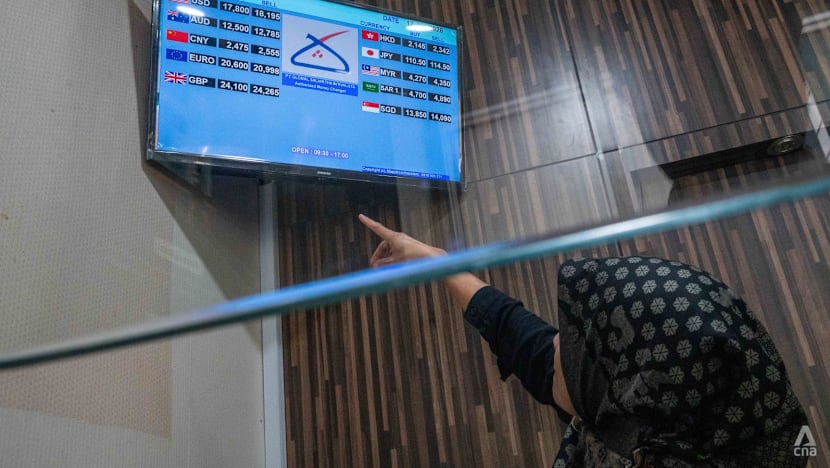 A customer checks foreign exchange rates at a money changer in Jakarta on Jun 10, 2026. The Indonesian rupiah has faced pressure in recent weeks. (Photo: CNA/Ridhwan Siregar)
A TEMPORARY SOLUTION
The latest rate hike and efforts to raise yields may help support the rupiah in the short term, analysts said, but not in the long term.
A higher rate makes rupiah-denominated assets more attractive to investors because they can earn higher returns by holding Indonesian financial instruments.
That can help slow capital outflows and support the currency, said Muhammad Faisal, executive director of Centre Of Reform On Economics (CORE) Indonesia.
“We can already see the impact,” said Faisal. “The rupiah, which had been steadily weakening recently, is now starting to stabilise.”
After hitting an all-time low on Monday, the rupiah strengthened to 18,141 on Tuesday and 17,971 on Wednesday.
The Indonesian stock exchange has also bounced back from its lowest dip in five years.
It traded at 5,902,37 at the end of Wednesday, after reaching its lowest level in five years on Monday at 5,342.14.
However, "for the overall economic improvement, it is certainly not enough with just one or two policies", Faisal said.
Since the bigger issue is trust, businesses and investors must believe the government’s policies are heading in the right direction and that there is effective governance, he said.
Similarly, Wijayanto Samirin, an economist and public policy expert from Paramadina University, agreed the interest rate move was useful but only as a temporary stabiliser.
He said Bank Indonesia’s decision to raise its benchmark rate to 5.5 per cent was “long-awaited” by money market players because the gap between Indonesian yields and US Treasury yields had become too narrow. The increase, he said, helped strengthen the rupiah.
But Wijayanto warned the measure “only treats the symptom”.
He said boosting yields and preserving financial market liquidity were both important, but also pulled in opposite directions. Higher yields can support the rupiah, but may reduce liquidity and make life harder for businesses.
“The most important thing is to maintain the balance between the two,” he said.
Meanwhile, Bhima from CELIOS warned that for households and businesses, a higher benchmark rate can also mean more expensive borrowing.
Banks may raise rates on mortgages, consumer loans, credit cards and working capital loans. That can make it harder for people to buy homes or cars, and for businesses to expand or hire, he said.
 Indonesian Finance Minister Purbaya Yudhi Sadewa attends a monthly media briefing on the state budget at the finance ministry in Jakarta on Jun 5, 2026. (Photo: AFP/ Yasuyoshi Chiba)
FINANCE MINISTER RESHUFFLE?
Amid market pressure, rumours have circulated about whether Finance Minister Purbaya Yudhi Sadewa, who replaced veteran Sri Mulyani Indrawati last September, could be reshuffled.
Analysts said the speculation is newsworthy not only because it concerns a key economic post, but because it reflects what markets are looking for: A figure who can communicate clearly, has credibility with investors and is seen as capable of managing fiscal risks.
Once a low-profile technocrat who led a deposit insurance agency, Purbaya came into the job with a can-do attitude, often making what experts deemed as brash remarks and bold fiscal moves. His predecessor Sri Mulyani was known for her prudent approach to fiscal discipline.
He has redirected Indonesia’s “rainy day funds” to stimulate the economy, a move economists have criticised and has yet to pay off.
Bhima said Purbaya’s communication style - often challenging criticism - had affected trust and that markets wanted a figure who could calm the situation.
Purbaya’s statements have not reassured investors, and finance policies taken so far have not solved the underlying problems, he added.
Over the weekend, Purbaya denied he was resigning and sought to push back against the “Sell Indonesia” narrative, saying that despite recent market turbulence, the country’s “fiscal condition is good and our economy is in good shape”.
“The ‘Sell Indonesia’ trend that I’ve been reading about is misguided,” he said.
Eko Listiyanto, an economist at the Institute for Development of Economics and Finance (INDEF), said the rumours about replacing Purbaya reflected a market desire for a credible figure with a track record and a more holistic understanding of the market.
He noted that there was talk of former finance minister Chatib Basri as a replacement because of his reputation and previous experience.
But Eko cautioned that any new minister would struggle if they were not empowered to propose more logical, market-friendly policies.
“If a new minister comes in but does not dare to put forward more concrete ideas, more logical to the market, it will be difficult,” he said.
He said markets would not be satisfied by a one- or two-day rally if the underlying concerns over state spending and fiscal direction remained.
Investors, he added, were looking for structural correction, including clarity over major programmes such as the free nutritious meal programme.
Faisal of CORE Indonesia said any Cabinet reshuffle or adjustment to major government programmes would need to be accompanied with concrete steps to show that fiscal management was improving.
Wijayanto said a personnel change might improve communication, but would not be significant if the policy direction remained the same.
“The ministry of finance has limited authority. Major corrective ideas and policy changes must come directly from the president,” he said.
 Elementary schoolchildren eating food from the government's free meal programme at a classroom in Jakarta, on Jun 23, 2025. (Photo: AFP/Bay Ismoyo)
FREE MEALS, DANANTARA AND FUEL PRICE
Observers also said the government’s surprise announcements of policies, or programmes that could affect fiscal sustainability, have also hampered confidence.
Eko said the markets had been unnerved by policies such as the establishment of the new government body, Danantara Sumber Daya Indonesia (DSI), which will manage the export of key commodities such as crude palm oil, coal and ferroalloys.
DSI is under the sovereign wealth fund Danantara, which itself has been the subject of transparency and governance concerns among economists like Wijayanto from Paramadina University.
Bhima said uncertainty over Danantara, which aims to manage the assets of all state-owned enterprises in the country worth more than US$900 billion, had added to pressure on the rupiah, as it affected export rules and foreign exchange inflows.
Meanwhile on Wednesday, state energy firm Pertamina made a surprise move of raising the price of Pertamax, Indonesia’s non-subsidised RON92 gasoline, by over 30 per cent from 12,300 rupiah (US$0.69) per litre to 16,250 rupiah. It cited higher global oil prices and movements in the rupiah exchange rate.
Indonesia, Southeast Asia’s largest economy, is an oil importer and has been hit by elevated crude oil prices since Israel and the United States launched strikes on Iran on Feb 28.
Pertamax’s price increase means some consumers may switch to subsidised fuels such as Pertalite, priced at 10,000 rupiah per litre, potentially increasing pressure on the government's fuel subsidy bill, said analysts.
While Wijayanto noted that Pertamax accounts for only a small share of overall fuel demand, he said it is important for the government to ensure the availability of Pertalite and biosolar so that long queues do not trigger panic.
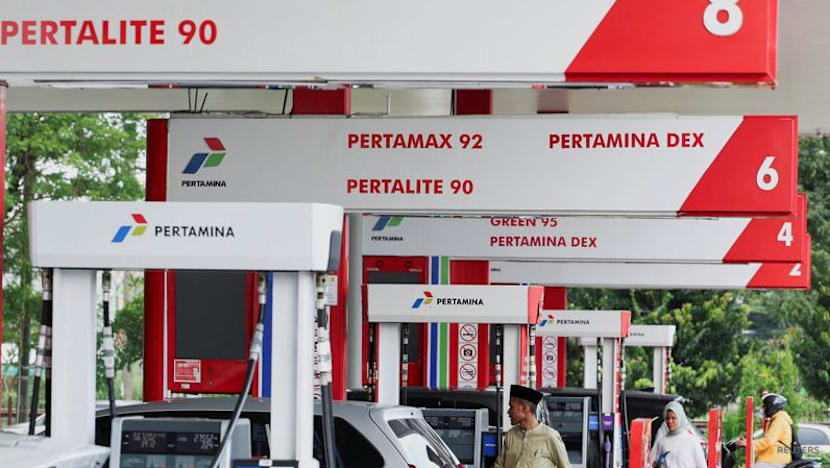 Workers fill up vehicles at a petrol station of the state-owned company Pertamina in Jakarta, Indonesia on Mar 10, 2026. (File photo: Reuters/Ajeng Dinar Ulfiana)
Coordinating Minister for Economic Affairs Airlangga Hartarto said on Wednesday that his ministry is preparing a stimulus package to lessen the effects of the Pertamax price hike.
"It's still being prepared. Once a decision has been made, we'll let you (the public) know. I have to report to the president first," Airlangga told journalists.
On negative international narratives such as “Sell Indonesia”, Eko from INDEF said the government needs to respond more carefully by using data, and through policy corrections that align with market logic.
He said officials should not answer criticism from foreign media or investors defensively or emotionally.
Investors and rating agencies were mainly worried about fiscal sustainability, including large debt maturities and whether government revenue would be enough to meet spending needs, Eko said.
The way to stop a “Sell Indonesia” narrative and restore credibility in the longer term was to show credible fiscal correction, reduce policy surprises and avoid statements that appear hostile to foreign investors, he said.
“Answer the criticism by showing better performance,” he said.
Several analysts pointed to the free nutritious meal programme, known locally as MBG, as a central concern because of its large budget allocation and recent graft case concerning its sacked heads.
Bhima said the programme, originally set to cost 335 trillion rupiah this year but has since been cut to 268 trillion rupiah, should be placed under a short-term moratorium, alongside a pause in other large projects, while the government designs stimulus measures and evaluates budget efficiency.
He said that without a legal and transparent mechanism to revise spending, statements about cutting or improving programmes would be seen as cosmetic.
Faisal from CORE Indonesia also said the free meal programme should not only be reduced but made more targeted and effective, while proving that it did not add fiscal risk.
Eko said the government should ensure ideas are tested before being announced, and use any savings from large programmes to cushion the public from the effects of rupiah weakness and rising costs.
For ordinary Indonesians, a weaker rupiah and a falling stock market may feel distant at first, said observers.
But they said the pressure can eventually show up in higher prices for imported goods or locally produced items with imported components, such as staple foods like tofu and tempe, higher fuel or transport costs, higher borrowing costs, slower business activity, and weaker hiring.
Bhima said while malls and cafes in big cities are still crowded, it should not automatically be read as a sign of a healthy economy.
Instead, he said, it could be part of a phenomenon in which people continue buying small luxuries or affordable pleasures because larger goals, such as buying a home, saving for education, or building long-term security, feel increasingly out of reach.
The government is trying to boost the economy by holding a nationwide shopping sale from Jun 8 to Jul 12, offering discounts of up to 50 per cent, involving around 800 brands, 80,000 retail outlets, and at least 414 malls and retail centres across 24 provinces.
The initiative is designed to stimulate household consumption and create wider economic impact for businesses and tourism players, the ministry of tourism said in a statement. It views the current exchange rate situation as an opportunity to attract regional visitors, such as from Malaysia, Singapore and Brunei.
At the end of the day, experts said Indonesia has the tools to calm the markets but confidence will return only if investors and the public see that the government is willing to acknowledge problems and fix them.
“The rupiah and JCI were worsened by several government policies that were not firm, not well socialised, and had no market test,” said Eko.
“I think what we really need to do now is reduce new policies that have the potential to become new polemics in the market. New ideas have to be tested first,” said Eko.








 English (US) ·