


 12 hours ago
7
12 hours ago
7
ADVERTISE HERE
KUCHING: Sarawak is targeting a 60 per cent rice self-sufficiency level (SSL) by 2030, up from about 21 per cent currently, through increased mechanisation and technology-driven paddy cultivation.
Minister of Food Industry, Commodity and Regional Development Datuk Seri Dr Stephen Rundi Utom said the government had allocated RM1 billion for paddy sector development and identified about 14,000 hectares of land with potential for cultivation.
He said development would begin on 2,000 hectares of state land through the Design, Build, Operate and Transfer (DBOT) approach, with the government providing infrastructure and private operators managing cultivation.
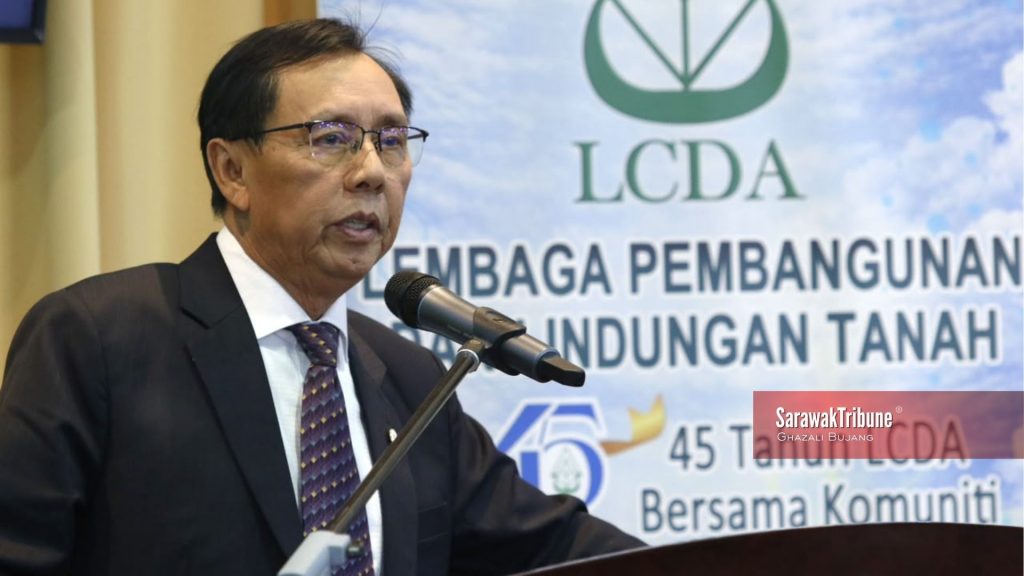 Rundi delivers his speech
He was speaking after witnessing the signing of a memorandum of sub-lease between LCDA Agri Business Sdn Bhd and Onemas Agriculture Sdn Bhd at the Sarawak Legislative Assembly complex here today (Oct 13).
Under the agreement, 143 hectares at Sungai Loba Pasi, Sarikei, will be developed for high-yield paddy production, including hybrid seed development.
Rundi said the initial harvest from the hybrid paddy cultivated by Onemas Agriculture reportedly reached 11.08 metric tonnes per hectare, compared with about 1.5 to two metric tonnes per hectare under traditional cultivation methods.
He said mechanisation, covering land preparation, planting, pesticide spraying, harvesting and drying, could reduce reliance on manual labour and improve productivity.
The project will be implemented in phases over six years, covering infrastructure, irrigation, cultivation and research facilities.
The Saromas hybrid paddy development programme combines the Louyou 8 variety from Wuhan, China, with local paddy varieties to produce hybrid seeds aimed at improving productivity in Sarawak.
Rundi said the government had also gazetted several areas in Limbang and Lawas for paddy cultivation to ensure the land continued to be used for that purpose, with plans to gazette more suitable areas.
He said increasing local rice production was essential to safeguarding Sarawak’s long-term food security.
“Food security is something that cannot be measured in monetary terms alone. If rice is not available to buy, what are we going to eat?” he said.
He added that higher paddy production could also support downstream industries, including rice vermicelli and laksa manufacturing.




 English (US) ·