


 4 months ago
192
4 months ago
192
ADVERTISE HERE
KUALA LUMPUR: At his home beside the Rusila mosque in Marang, Terengganu last Friday (May 22), Parti Islam Se-Malaysia (PAS) president Abdul Hadi Awang warned that his party’s patience was wearing thin.
He accused opposition coalition partner Parti Pribumi Bersatu Malaysia (Bersatu) of “playing out” PAS by seeking to field multiple candidates during elections despite barely mustering any grassroots machinery on the ground.
Then he took aim at what he described as Bersatu declining to strengthen the Perikatan Nasional (PN) coalition by restricting the entry of new component parties, a move he felt was disconcerting.
These disagreements have prompted PAS - which leads PN - to review its partnership with Bersatu, Hadi said.
“We have our patience but our patience has its limits. Elections are near but if cooperation in Perikatan affects our electoral results, then we have to do what is necessary,” he said.
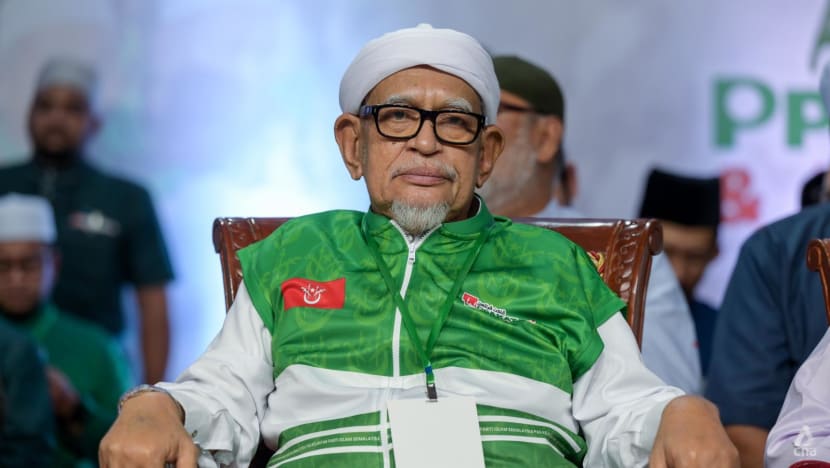 PAS president Abdul Hadi Awang at a rally in Kota Bharu, Kelantan ahead of the state election in 2023. (File Photo: CNA/Fadza Ishak)
Bersatu’s response was swift, saying later that day it was taking Hadi’s comments seriously. On Sunday, the party, whose president is the former prime minister Muhyiddin Yassin, released a lengthy six-page response via social media.
Bersatu’s political bureau rejected allegations that the party did not support the addition of new members to PN, saying it was open to forming electoral pacts with them first before weighing membership applications.
The bureau also insisted the party was “continuously striving” to improve its grassroots support, pointing to “hundreds of new membership applications daily” in recent months while taking a veiled swipe at its partner’s right-wing Islamist brand and appeal.
“Bersatu’s moderate image, inclusivity, progressiveness and people-centric policies, as well as credible experience have propelled voter support for Bersatu candidates and other parties within Perikatan Nasional,” it said.
PN’s other members are the minority-centric parties Parti Gerakan Rakyat Malaysia and the Malaysian Indian People’s Party.
Analysts told CNA the increasingly public spat between Malaysia's main opposition parties is pushing their relationship to the brink, with PAS wary of being dragged down by Bersatu's troubles and seeking a new partner as national polls loom.
Malaysia must hold its next general election by February 2028, but Prime Minister Anwar Ibrahim has said he could call snap polls amid shifting political winds.
PAS’ new partner could very well be a party that takes in Hamzah Zainudin - Muhyiddin’s sacked former deputy - and his followers, the analysts said.
This is why PAS’ perception that Bersatu was blocking new parties from joining PN has become a major source of friction, they added.
“I think the cracks are getting bigger ... I truly believe this is the first of signals that PAS is seriously thinking of working with others,” said political analyst Syaza Shukri of the International Islamic University Malaysia (IIUM).
“At this rate, I wouldn’t be surprised if it leads to a break-up.”
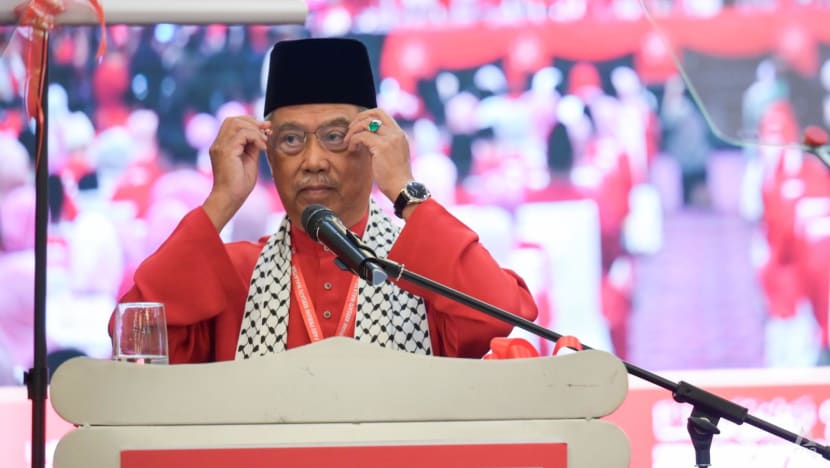 Bersatu president Muhyiddin Yassin speaking at his party's 2023 convention held in Shah Alam, Selangor in November 2023. (Photo: CNA/Fadza Ishak)
But observers cautioned that the growing opposition disarray does not mean Anwar should pounce by calling a snap election. They pointed to internal troubles within his own Parti Keadilan Rakyat (PKR), the broader Pakatan Harapan (PH) coalition, and the unity government pact.
“The PAS-Bersatu fracture is politically useful to Anwar, but not enough on its own to justify snap polls,” said Asrul Sani, associate vice-president at strategic advisory firm The Asia Group.
“Anwar still faces complications within his own camp, including UMNO-PKR seat tensions, Rafizi’s Bersama project, and possible PKR defections.”
The analyst was referring to how the United Malays National Organisation (UMNO) - the lynchpin party of the Barisan Nasional (BN) coalition - has declared it will contest all seats in the upcoming Johor state election despite being in the unity government with PH.
Former PKR deputy president Rafizi Ramli - a former economy minister-turned-government critic - also quit the party on May 17 before joining Parti Bersama, saying he wanted it to be a platform for citizens who believe that political power belongs to the people.
Rafizi retains the support of several PKR MPs, raising fears they could also quit Anwar’s party and split incumbent votes in urban seats.
THE HAMZAH FACTOR
There are parallels with the situation in Bersatu.
Hamzah, the former opposition leader in parliament, has been somewhat of a thorn in Bersatu’s side since being kicked out of the party on Feb 13 amid a power struggle and a purge of dissenting senior party members.
This included those who were seen as pushing for Hamzah to take over as Bersatu president from Muhyiddin.
The day after he was sacked, Hamzah launched what he called a “Reset” movement and is now reportedly set to take over a new party, with other ousted Bersatu leaders expected to follow.
On Monday, former Melaka chief minister Rahim Thamby Chik claimed on social media that more than 200,000 Bersatu members who have either left or remain with the party are backing Hamzah’s Reset movement.
Azmi Hassan, a senior fellow at the Malaysia-based think tank Nusantara Academy for Strategic Research, said PAS wants to get rid of Bersatu because the latter is perceived as blocking Hamzah's return to PN, as alluded by the PAS president Hadi.
“Before this, there was some manoeuvring that PN will accept new political parties, and that Hamzah can be part of these political parties so that Hamzah and his team can be part of PN,” he said.
The fact that Hadi made a public statement about it shows PAS wants Bersatu to leave PN voluntarily, said Azmi, noting that PAS, at this point, values a partnership with Hamzah more than with Bersatu.
“But Bersatu sees that Hamzah in PN is a threat to Bersatu - no doubt about that,” he added.
 Then-opposition leader Hamzah Zainudin (right) and Kota Bharu MP Takiyuddin Hassan - who is also PAS secretary-general - speaking to media in Malaysia's parliament on Dec 19, 2022. (Photo: CNA/Fadza Ishak)
This is because he carries Malay nationalist credibility, government experience, and a political network that extends beyond Bersatu, said Asrul from The Asia Group.
Hamzah was Malaysia’s Home Affairs Minister from 2020 to 2022, and Minister of Domestic Trade, Cooperatives and Consumerism from 2015 to 2018.
“For PAS, his return in some PN capacity would be useful. It would help PAS project itself as part of a broader Malay opposition front, rather than a party defined solely by Islamist politics,” Asrul said.
For Bersatu, however, his return could be disruptive, noted Asrul.
“Hamzah represents a competing centre of influence within Bersatu’s political space. His presence would sharpen the perception that Bersatu under Muhyiddin is becoming increasingly isolated within PN.”
Furthermore, Hamzah’s past involvement with fundamentalist Islamic groups in Malaysia means he shares “chemistry” with Hadi, making him an “ideal partner” rather than the “traditionally oriented” Muhyiddin, said Ahmad Fauzi Abdul Hamid, a political science professor at Universiti Sains Malaysia (USM).
“The latest developments are no surprise at all. PAS wants a tie-up with the expelled Hamzah-led faction or Reset faction, not with the Muhyiddin-led faction. Muhyiddin is regarded as a spent force,” he argued.
WHAT'S NEXT FOR PAS AND BERSATU?
Signs of a deepening rift between PN’s two largest component parties were on display as early as last December, when eight Perlis assemblymen, five of whom were from Bersatu, withdrew support for a PAS chief minister in a move widely seen as orchestrated by figures aligned with Muhyiddin.
The fallout deepened mistrust between PAS and Bersatu and ultimately preceded Muhyiddin’s resignation as PN chairman.
Fauzi said PAS and Bersatu cannot continue working together unless Muhyiddin does a U-turn by re-admitting Hamzah and his Reset compatriots into Bersatu “unconditionally”, and laying out a roadmap for his resignation as president.
If the parties do end up splitting, Bersatu would “definitely be worse off”, he said.
“Bersatu even lacks adequate grassroots machinery for election canvassing purposes. As I've said, PAS will be content to leave out the Muhyiddin faction from the scenario,” he added.
The Asia Group’s Asrul said Bersatu would likely take the harder hit as its current parliamentary strength is partly a function of PAS’ willingness to step aside in some Malay-majority seats.
PAS currently holds 43 of 222 seats in Malaysia’s lower house of parliament, while Bersatu holds 19.
“If that accommodation disappears, Bersatu would face multi-cornered fights,” he said.
“PAS has a more defensible core. Its base in Kelantan, Terengganu, Kedah and Perlis is ideologically loyal and less dependent on coalition arrangements.”
If Bersatu goes solo, it would need to broaden its reach, possibly by engaging Sabah and Sarawak-based opposition parties or positioning itself as the anchor of a wider non-PH alternative, Asrul said.
“PAS, meanwhile, would likely double down on Islamic identity rhetoric together with cost-of-living frustrations. Its strength rests in ideological loyalty, religious credibility and grassroots mobilisation,” he said.
While Asrul feels a complete break is not inevitable, he said the political value of a PAS-Bersatu partnership is “clearly diminishing”.
“For PN, the real danger is credibility. A coalition visibly at odds with itself stops looking like a government in waiting and starts looking like a temporary electoral vehicle,” he added.
“PN may survive in form, but its internal trust and strategic coherence would be badly weakened.”
Even if PAS and Bersatu part ways, IIUM’s Syaza thinks they could still form an electoral pact given that national polls might be imminent.
“It’s just that maybe PAS does not want to be dragged by Bersatu’s problems and affect the PN brand,” she said.
“Right now Muhyiddin doesn’t want to work with Hamzah. But if there’s no PN and everyone just comes together for an electoral pact, they could all work together.”
Syaza believes Bersatu – in its current form under Muhyiddin – and Hamzah’s breakaway Reset faction are “almost at similar strength”.
BIGGER PROBLEMS IN PAKATAN HARAPAN?
As for Anwar, while the spiralling dispute between PAS and Bersatu may give the premier “some breathing space”, he needs to “focus on his delivery as PM” and attend to issues his own coalition faces, Syaza said.
Anwar does not appear to have a response yet to Rafizi's Bersama party, said Azmi from the Nusantara Academy.
At the same time, Anwar needs to “pacify” coalition partner Democratic Action Party (DAP), which could in turn alienate Malay voters, said Azmi.
A key component of PH, DAP has put pressure on Anwar in recent months by pushing for institutional reforms and promoting ethnic minority bases, sparking friction with Malay-centric coalition partners like UMNO.
DAP will also hold a special congress on Jul 12 to assess its participation in the unity government.
Members will vote on whether senior leaders should resign from their government and ministerial posts even as the party pledged to continue backing Anwar’s administration until the end of the current term.
“So compared to the problems of the opposition, I think the problem faced by PH is much bigger,” Azmi said.
While Syaza felt Anwar could call an early election “just to stop Rafizi from organising further”, Fauzi from USM felt otherwise.
“What's worrying (for Anwar) is the dithering attitude of BN-UMNO to the possibility of a PH-BN tie-up as the unity government draws to a close. Now BN and UMNO speak confidently as a quasi government-in-waiting,” he said.
“It refuses to cooperate with PH in Johor, and almost brought down the PH-led government in Negeri Sembilan.”
The Negeri Sembilan state government was plunged into leadership turmoil in April after all 14 of UMNO’s assemblypersons withdrew their support for chief minister Aminuddin Harun and were subsequently backed by five PN assemblypersons, threatening to form an alternative government by simple majority.
While UMNO secretary-general Asyraf Wajdi Dusuki said the party respected the position of its assemblymen, he stated that UMNO will continue to support the current Negeri Sembilan government to preserve stability and public welfare.
Aminuddin - a PKR vice-president - remains in office after the state ruler Tuanku Muhriz Tuanku Munawir decreed for him to stay on until the constitutional majority issues were resolved, though a snap state election has not been ruled out.
Beyond political dynamics, Asrul from The Asia Group said the bigger issue for Anwar is the economy.
“Rising prices, cost-of-living pressures, and subsidy rationalisation make an early election risky. The government may be able to stretch existing subsidies into next year, but only with continued fiscal pressure and gradual adjustments,” he said.
“Snap polls could backfire if voters see them as a mandate for unpopular cuts. Voters ultimately judge governments on what they feel in their wallets.”




 English (US) ·