


 6 months ago
111
6 months ago
111
ADVERTISE HERE
analysis Asia
The failure to pass the Bill has exposed significant coordination gaps and "uneven political commitment" within the Anwar Ibrahim administration, say analysts.
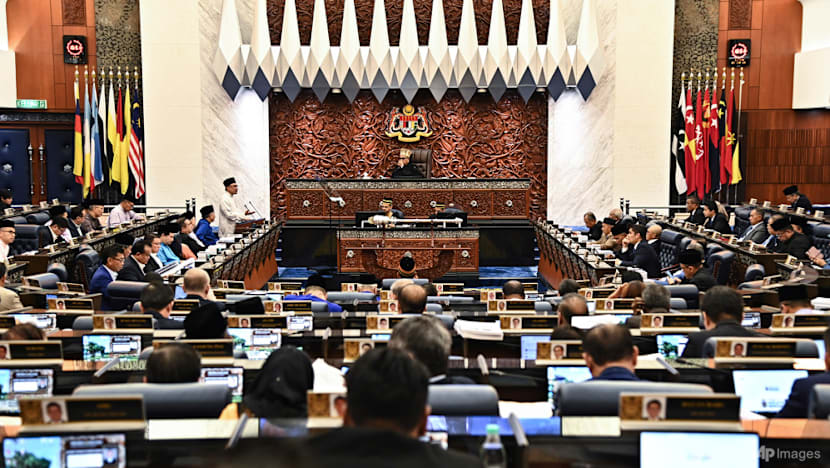
Malaysia's Prime Minister and Finance Minister Anwar Ibrahim (centre left) delivering the 2025 budget speech at parliament in Kuala Lumpur on Oct 18, 2024. (File photo: AP via Malaysia Department of Information)
New: You can now listen to articles.

This audio is generated by an AI tool.

KUALA LUMPUR: The failure of the Anwar government to see through a landmark Bill that would limit the tenure of a sitting prime minister to just two terms - or a maximum of 10 years - serves as a “reality check” for the administration, analysts say, as they warn that parliamentary support for political stability does not necessarily equate to unconditional support for a reforms agenda among some.
On Monday (Mar 2), the government fell just two votes short of the 148 required to pass a Bill that would amend the constitution, a result that some observers and politicians from the ruling side said was due to “poor management”.
Following this, the government on Tuesday decided to defer another highly anticipated Bill aimed at separating the roles of the attorney general and the public prosecutor. Instead, it will be examined by a new bipartisan parliamentary committee.
While it was a setback for Prime Minister Anwar Ibrahim - who faces pressure to pass reforms from his coalition members - analysts however did not think that the issue would have significant impact or pressure on his administration for now.
Syaza Shukri, a political scientist at the International Islamic University Malaysia (IIUM), told CNA that the episode showed that compromises were still needed to reach consensus among the different political parties in the unity government.
Anwar’s administration is made up of the Pakatan Harapan (PH) and Barisan Nasional (BN) coalitions, as well as Gabungan Parti Sarawak (GPS) and Gabungan Rakyat Sabah (GRS) among others.
There are 222 members in Malaysia’s parliament, with 147 officially supporting the government and 75 in the opposition. The 75, however, includes six Members of Parliament who were sacked from the opposition Parti Pribumi Bersatu Malaysia for declaring their support for Anwar back in 2023.
“There may have been administrative gaps. I know people are talking about party whip and their role. But for me ultimately it is a political test. I think it reflects uneven political commitment more than mere technical oversight,” said Syaza.
During the bloc vote in parliament on Monday, the Bill received 146 votes - two short of the 148 required for a minimum two-thirds majority needed to pass any constitutional amendment. Speaker Johari Abdul had said that a total of 32 MPs were absent while another 44 did not vote.
Eight parliamentarians on the government side were not present during the voting on the Bill, which took place at about 6.30pm on Monday before the results were announced about 20 minutes later.
The opposition coalition Perikatan Nasional (PN) - which abstained from voting - had largely celebrated the defeat of the Bill, pointing out that it was the first time a proposed Bill had failed to pass during Anwar’s administration.
“Right now, the damage is symbolic. It dents the reform narrative,” said Syaza.
Hisomuddin Bakar, the executive director of research firm Ilham Centre, stressed that the Anwar administration still retains procedural space and time to reintroduce both Bills in a future parliamentary sitting.
“Moving forward, the administration should treat this episode as a lesson in coalition management and parliamentary arithmetic,” he said, adding that the incident should not be viewed as a collapse of political support within the unity government.
 Malaysia's Prime Minister Anwar Ibrahim speaks as he attends a business and investment conference, during Pakistan Prime Minister Shehbaz Sharif's official visit in Kuala Lumpur, Malaysia on Oct 6, 2025. (File Photo: Reuters/Hasnoor Hussain)
FAILURE TO GET THE NUMBERS
Under Malaysia’s Westminster parliamentary system, there is no limit on the length of a prime minister’s tenure. The government’s rationale to introduce a cap was to avoid the concentration of power around one individual and allow for fresh leadership and perspectives.
The 10-year term limit for the highest office in the country was among a slew of various reforms proposed by Anwar that were aimed at boosting urban support for his administration.
In its manifesto for the 2022 general election, PH had pledged a term limit for the prime minister, following up on a similar proposal in the run-up to the previous polls in 2018.
Anwar had also previously stated that lengthy tenures lasting 22 years had “damaged the country” - in a jibe at former premier Mahathir Mohamad, whose 22 years in office from 1981 to 2003 produced achievements but was also characterised by a concentration of power around the executive.
Ahmad Fauzi Abdul Hamid, a political science professor at Universiti Sains Malaysia (USM), viewed the defeat of the Bill as the failure of the government to discipline its rank and file.
“It would seem that the whip was not enforced,” he told CNA.
“If you cannot enforce the two-thirds support at a time you need it, what’s the use of it?” said Ahmad Fauzi, who added that absences might have stemmed from genuinely unavoidable circumstances.
While all PH MPs had voted in support of the Bill, there were three from BN who were not present: Sembrong MP Hishammuddin Hussein, Tapah MP M Saravanan and Libaran MP Suhaimi Nasir.
The other five MPs on the government side absent during Monday’s vote were Keningau MP Jeffrey Kitingan of GRS, Julau MP Larry Sng of Parti Bangsa Malaysia, Bukit Gantang MP Syed Abu Hussin Hafiz who is an independent, Lawas MP Henry Sum Agong of GPS, and Tenom MP Riduan Rubin of Parti Kesejahteraan Demokratik Masyarakat.
Sng told The Star that he was stuck in traffic before the vote, and that he had several engagements elsewhere.
"By the time I got the call to return, it was only about three minutes before voting commenced. I rushed back but the traffic congestion did not make it possible," he said, adding that he supported the Bill and denied elements of sabotage.
Suhaimi was reported to have been hospitalised while Saravanan said he had been attending prayers. Riduan, meanwhile, said that he had to be in his constituency that was facing severe flooding at the time.
One opposition MP - Syed Saddiq of MUDA - voted for the Bill.
Parti Keadilan Rakyat (PKR) MP Wong Chen - who is part of PH - said that the failure to pass the Bill was due to poor management of the voting count and logistics of the government.
“I spoke to an absent MP who said that he was simply not properly informed to turn up. He received a text a few days ago, but thought the Bill was deferred and there were no follow-up phone calls to him or his staff,” he said in a Facebook post on Mar 3.
Hisomuddin said that effective parliamentary management requires strict whip discipline, accurate head counting, and guaranteed attendance during critical votes.
“The failure to ensure numbers on the government bench indicates lapses within the Government Backbenchers’ Club and party whips. In tightly balanced legislatures, technical miscalculations can produce politically significant outcomes,” said the research firm director, adding that the defeat was a significant failure in coalition discipline.
However, some analysts felt that the failure went beyond logistics.
Ahmad Fauzi believes that because the Anwar administration is made up of different coalitions and parties with conflicting values, it lacked a shared foundation.
“It is clear that this government is not united by a common political ethos, but rather united for the sake of forming a government that is able to function at the bare minimum. We are now seeing the reality check of that arrangement,” he said.
In a Facebook post on Monday, Democratic Action Party (DAP) secretary-general Anthony Loke said he was “deeply saddened” by the result, saying that his party had worked to realise the reform agenda. The DAP is part of the PH coalition.
“Civil society and voters who wish to see institutional reform in the country must condemn and question the Members of Parliament who were absent and did not support this amendment, including the opposition bloc,” said Loke, who is Transport Minister.
But the opposition had been against the Bill from the onset, arguing that limiting a prime minister's term might infringe upon the King’s discretionary powers.
Leader of the Opposition Hamzah Zainuddin said in a press conference on Tuesday that the government could not blame them for the outcome of the vote.
“You have the majority - 154 MPs support the government. If you want to ensure the Bill is passed, then make sure that two-thirds of them are present to vote. Call them one by one if necessary.
“If an MP is stuck in traffic, we can send a note to the minister to request an extension of the winding-up speech, since some are still on the way. I want to advise the government to learn from this so that such issues do not arise again,” he was quoted as saying by The Star.
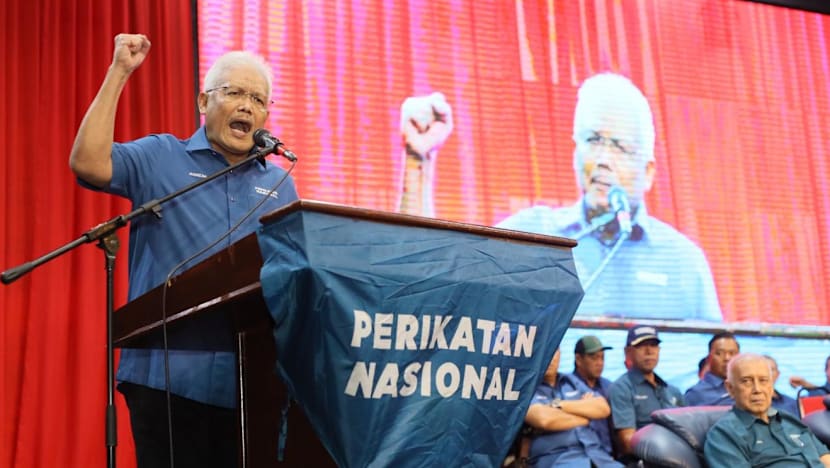 Opposition leader Hamzah Zainudin (Photo: Facebook/Hamzah Zainudin)
BACK TO THE DRAWING BOARD
Analysts whom CNA spoke to said that the government would have learnt its lesson from Monday’s debacle and thus decided to defer the Bill on the proposed separation of the attorney general and public prosecutor roles.
Even before the Bill was tabled, a group of 10 PKR MPs led by former economy minister Rafizi Ramli had threatened to withhold their support because they believed the Bill’s current draft did not provide enough "checks and balances".
On Tuesday, de-facto law minister Azalina Othman Said moved to refer the separation of powers Bill to a newly formed bipartisan special select committee for further scrutiny.
Azalina said that the 12-member bipartisan committee will rigorously scrutinise the Bill - specifically focusing on the accountability mechanisms for the public prosecutor - and is expected to recommend necessary amendments within a three-month window.
Hisomuddin believes the deferment underscores the need for broader and more intensive stakeholder consultation.
He said that institutional reform Bills - especially those touching prosecutorial independence - require inclusive engagement with legal bodies, civil society, opposition parliamentarians and constitutional experts.
In recent years, politicians across both sides of the aisle as well as senior members of Malaysia’s legal fraternity have called for the separation of the attorney general roles as both the government’s legal adviser and public prosecutor, citing what is perceived as an inherent conflict of interest.
As for the defeated Bill on the prime minister’s tenure, Syaza believed it could be salvaged because it was short of only two votes.
“The government needs to further its negotiations because a consensus for such an amendment is important. We don’t want the narrative of ‘bulldozing’ it,” she said.
The government has at times been accused by civil society organisations of fast tracking laws without proper consultation.
For now, the government is technically barred from reintroducing the prime minister’s term-limit Bill in its current form for the remainder of the year.
Under standing orders of the Malaysian parliament, a defeated Bill cannot be retabled during the same parliamentary session unless it undergoes substantial changes.
A parliamentary session is the annual cycle of parliament that begins with an opening ceremony by the King and continues through several months of meetings until it is officially ended to make way for the next year’s cycle.
Constitutional lawyer Joshua Wu told CNA that the government could, in theory, bypass the session-long ban by moving to suspend the Standing Orders, allowing it to retable the Bill even within the current session.
“If that happens, then theoretically, the government could retable the … Bill during this current parliamentary session. For example, during the upcoming second meeting from June to July or the third meeting from October to December, according to the Dewan Rakyat calendar,” he said.
Communications Minister Fahmi Fadzil - who is also the government spokesperson - was reported to have said on Wednesday that a motion to reintroduce the Bill will be tabled in June.
Fahmi said Deputy Prime Mininster Fadillah Yusof, who serves as government chief whip, had briefed the Cabinet on the eight MPs who were absent.
“Only two of them have submitted written explanations to the chief whip. We are still awaiting the remaining six,” the Edge reported him as saying.
GOVERNMENT STILL IN CONTROL: ANALYSTS
While Anwar’s government may have suffered a legislative blow, political observers argued that its impact should not be overstated.
Hisomuddin said the government remains intact, retains parliamentary control, and continues to govern.
“The episode highlights the complexities of coalition politics in a fragmented legislature rather than signaling imminent instability,” he said.
Hisomuddin added that he does not believe that the setback would have a significant impact on Anwar, but that it serves as an important turning point for the prime minister to refine the government’s headcount strategy in securing support moving forward.
Agreeing, Syaza said that Anwar still commands the majority of the parliament.
“There was no defection wave. No coalition collapse. No non-confidence vote,” she said, adding that moving forward, Anwar needs to control the narrative and acknowledge that “reforms were difficult”.
“So that’s why it needs time. He can also focus on one key reform instead of multiple reforms at once. Build consensus there first.”







 English (US) ·