


 8 months ago
116
8 months ago
116
ADVERTISE HERE
Jakarta's golden share in a Southeast Asian superapp would set a dangerous precedent for state power, say researchers.
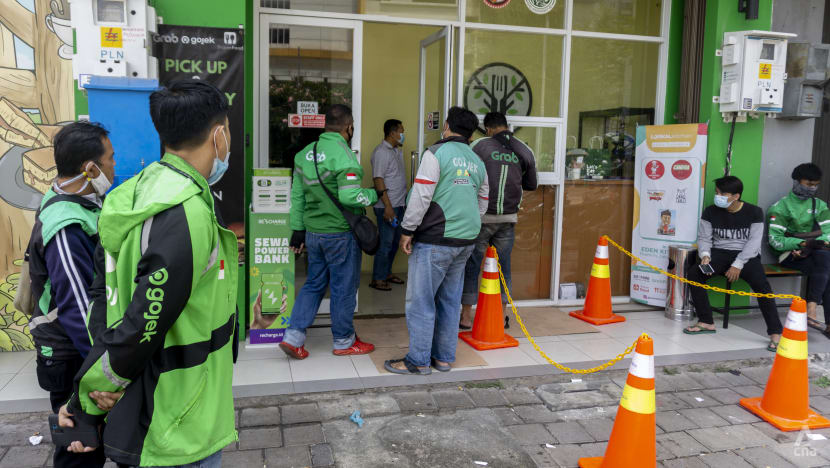 Indonesia’s digital economy has been one of Southeast Asia’s fastest-growing, driven by competition between superapps such as GoTo and Grab. (Photo: Nivell Rayda)
SYDNEY: Speculation is mounting over a potential merger between Southeast Asia’s two largest superapps – Indonesia’s GoTo, listed on the Indonesia Stock Exchange, and Singapore’s Grab Holdings, listed on the Nasdaq in the United States. If approved, the combined entity could control up to 91 per cent of Indonesia’s ride-hailing market.
This consolidation makes commercial sense. Ride-hailing, food delivery and digital payments are costly businesses, and sustaining head-to-head competition has proven expensive. Greater scale could reduce losses, stabilise pricing, and eliminate duplication. A monopoly in which one large network no longer needs to compete with rivals for driver-partners and merchant-partners is welcome news for investors.
For Indonesia, however, the issue is not just balance sheets. The challenge is improving conditions for driver-partners and merchant-partners while strengthening consumer protections.
That raises a harder question: Is agreeing to the government’s demand for a “golden share” – which would allow it veto power over key corporate decisions without majority ownership – the right way to manage consolidation? Can it lift welfare and preserve competition without deterring investment or weakening regulatory credibility?
PUSH FOR MERGER
Indonesia’s digital economy has been one of Southeast Asia’s fastest-growing, driven by competition between superapps such as GoTo and Grab. Under the current system, driver-partners, merchant-partners and consumers can choose between digital platforms depending on the terms and incentives offered.
This rivalry has driven competitive pricing, enhanced services, produced more intuitive user interfaces and driven broader coverage nationwide – fostering innovation that delivers affordable and high-quality services.
The push for the merger is largely driven by investors keen to consolidate their holdings and secure a clear path to profitability. SoftBank, which has a stake in nearly every major ride-hailing market globally and in both GoTo and Grab, sits at the centre of this strategy. It has a consistent pattern of favouring consolidation over competition in ride-hailing markets, including the Uber-Didi merger in China and the Uber-Grab merger in Singapore.
Both GoTo and Grab have now turned a corner financially. GoTo posted its first annual profit after years of losses, while Grab reported net income in recent quarters. Their journeys reflect a broader trend in Southeast Asia, where digital platforms are maturing, scaling up and finally proving their business models can work.
The proposed golden share arrangement reflects President Prabowo Subianto’s broader ideological outlook of state capitalism. In his book, The Indonesian Paradox And Its Solutions, he writes admiringly of Deng Xiaoping’s early development model, under which rapid economic growth was driven by strong state control over strategic industries and resources. Prabowo argues this aligns with Article 33 of Indonesia’s constitution, which enshrines economic nationalism by mandating state control over strategic assets.
 Indonesia's President Prabowo Subianto gestures following the 28th ASEAN-Japan Summit, as part of the 47th ASEAN Summit in Kuala Lumpur, Malaysia Oct 26, 2025. REUTERS/Chalinee Thirasupa/Pool
GOLDEN SHARE MODEL IS FLAWED
The plan to use a golden share through Indonesia’s sovereign wealth fund Danantara is inherently flawed. The government’s stated objective – prioritising social welfare over profit – is precisely what effective, independent regulation should achieve. A golden share sidesteps this framework, replacing transparent rules with discretionary state power.
This conflates two distinct mechanisms: regulation and ownership. Regulation establishes clear, evenly applied rules enforced by independent bodies. A golden share grants veto power without accountability – the government meddles in commercial decisions without bearing responsibility for outcomes while undermining its own regulatory credibility. It becomes simultaneously referee and player.
Arrangements that allow governments to block or shape corporate deals, have proven problematic in other countries. China’s golden share model, which gives the state greater control over digital platforms through small stakes, may suit its political system. Yet it unsettles foreign investors by blurring the line between regulation and political control and could even breach US securities laws for US-listed firms.
Italy’s golden power, intended to protect strategic assets from foreign takeovers has likewise drawn a formal warning from the European Commission for its interventionist use, which risks breaching European Union law and undermining the single market.
RISKS FOR INDONESIA
Indonesia already possesses regulatory tools to protect social welfare in the digital economy: competition law, labour standards, consumer protections and digital platform oversight. Where enforcement proves inadequate, the solution is to strengthen institutions and modernise regulations, not to bypass established frameworks through a golden share that injects political discretion into technical decisions about pricing and service standards.
The precedent is dangerous. If adopted, this model would encourage opaque politicised arrangements across sectors, discouraging the long-term investment that depends on transparent rules. It pushes Danantara beyond managing state-owned enterprises into wielding disproportionate control over private companies. This creates precisely the uncertainty investors want to avoid.
A golden share risks swapping the predictability of markets and regulation for political discretion. It is a gamble in which government owns the downside. The government will be implicated if the consolidated firm proves overly dominant and predatory towards its captured market, including consumers, driver-partners and merchant-partners as well as smaller competitors or new entrants.
Conversely, directly intervening in corporate decisions to protect social welfare will risk damaging the firm’s commercial performance.
Indonesia has the potential to lead in the digital economy, given its large population and growing digital infrastructure. Yet this requires getting the fundamentals right: careful regulation, not ad-hoc state intervention.
Hilman Palaon is a Research Fellow at the Lowy Institute in the Indo-Pacific Development Centre. De Rizky Kurniawan is a public policy and regulatory professional with experience in shaping Indonesia’s digital economy and education reform. This commentary first appeared on Lowy Institute’s blog, The Interpreter.








 English (US) ·