


 3 weeks ago
35
3 weeks ago
35
ADVERTISE HERE
HOBART, Australia: Last weekend’s general assembly was not a routine party gathering of the United Malays National Organisation (UMNO). It was a declaration of intent.
“The time has come for GE16 to be held immediately,” said Ahmad Zahid Hamidi, UMNO president and deputy prime minister to Mr Anwar Ibrahim. Malaysia’s next general election (GE16) would be the moment to “reclaim the mandate to lead”.
Two state polls on the peninsula have likely boosted Mr Zahid’s confidence. UMNO-led coalition Barisan Nasional (BN) swept 48 of 56 seats in Johor in July and 18 of 36 seats in Negeri Sembilan in August.
But are two state wins enough for UMNO to want that national contest brought forward?
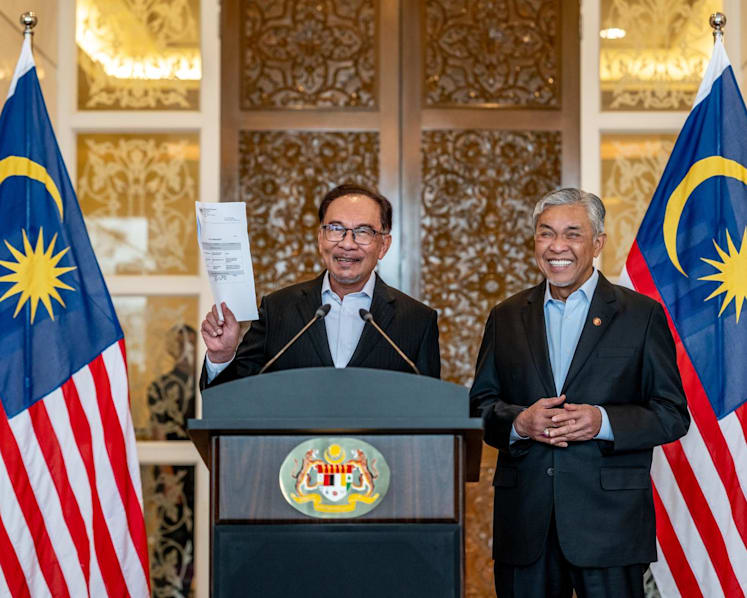 Malaysian Prime Minister Anwar Ibrahim and Deputy Prime Minister Ahmad Zahid Hamidi at a press conference announcing the Cabinet reshuffle on Dec 12, 2023. (Photo: Prime Minister's Office)
BETTING ON MALAY CONSOLIDATION
UMNO is seeing another lesson here: That a collaboration with Parti Islam Se-Malaysia (PAS), whether formal or tacit, has clear potential as an electoral machine in GE16. Together, BN and PAS formed a supermajority with 25 seats in Negeri Sembilan.
At the general assembly, Mr Zahid called for a “grand collaboration”. PAS leaders were invited to the meeting. Pakatan Harapan (PH) leaders were not.
The packaging was familiar. For me, the grand collaboration is a rebrand of the old Muafakat Nasional alliance between UMNO and PAS.
Even though Mr Zahid ruled out the possibility of a Muafakat 2.0 just months ago, he spoke last weekend of tafahum siyasi – a political understanding that would not merge parties or erase identities but stop Malays from clashing with one another.
The substance is the same: Malay-Muslim consolidation first, everyone else later. The difference this time is that non-Malay parties appear to be welcome to join the grand collaboration, with UMNO in charge.
PAS likely sees partnership with BN as its best shot to be part of the federal government and is willing pay the price of playing junior partner to UMNO.
HOW THE MATHS WORKS OUT
UMNO has not behaved like a partner anxious to preserve a coalition. The party has been openly undermining the unity government by cooperating with PAS to avoid splitting the vote in Johor and Negeri Sembilan, while still sitting in federal Cabinet.
At UMNO’s meeting, it openly dared Anwar to sack the party from government and call for early general elections. It is the behaviour of a party preparing the ground to take over the next government.
The arithmetic is brutal and simple. Looking at the combined performance of PAS and BN from the 2022 general election, they could easily win about 100 parliamentary seats in GE16.
That is short of the 112 simple majority needed to take Putrajaya on their own, but GE15 was widely recognised as a poor showing for BN. If the political winds have indeed changed and favour a “Malay Tsunami”, a united UMNO-PAS ticket could even win about 120 seats outright.
UMNO is also hoping to recapture some lost Malay ground, after spending nearly a full term governing alongside the Democratic Action Party (DAP), which is a component party of Mr Anwar’s PH coalition. Large parts of the Malay electorate still do not trust the DAP in federal government.
Mr Anwar, at least in public, insists UMNO remains part of the unity government under him. That posture looks less like strategy than political paralysis.
A deputy prime minister can call for immediate polls and dare the prime minister to kick his party out, and the latter’s reply is that the government is still intact. The best explanation for Mr Anwar’s behaviour is that he believes even if re-elected, he still needs and can get Mr Zahid to support him.
SHORING UP EAST MALAYSIA SUPPORT
Even if the calculus adds up on the peninsula, UMNO still has a problem in East Malaysia.
The dominant coalitions – Gabungan Parti Sarawak (GPS) in Sarawak and Gabungan Rakyat Sabah (GRS) in Sabah – do not want a Putrajaya with PAS as a central partner. They are not comfortable with PAS’s religious ambitions and rhetoric.
At the party’s annual congress in Kelantan on Sep 5, PAS president Abdul Hadi Awang said that non-Muslims should be confined to Cabinet portfolios dealing with implementation rather than policy formulation, which must be led by a Muslim minister. That is not the language of a coalition partner East Malaysia can accept.
It gives Mr Anwar an opportunity to secure backing from Sabah and Sarawak. But that means he has to deliver on the commitments under Malaysia Agreement 1963 (MA63).
Among the key demands are a larger share of oil and gas revenue and 35 per cent of seats in Parliament. Sabah also wants the issue of its entitlement to 40 per cent of federal revenue derived from the state that has been unfulfilled for nearly five decades.
Those are not small asks. They are the price of a political insurance policy.
On Saturday (Sep 12), after chairing a meeting on MA63 implementation, Mr Anwar said that the federal government has consented to increasing parliamentary representation from Sabah and Sarawak. He also said that Sarawak may get a federal revenue sharing arrangement in the same spirit as the one struck with Sabah.
Whether there can be any meaningful progress on these issues before GE16 remains to be seen, but it sends a clear signal to East Malaysian voters.
BUYING TIME
Faced with all these pressures, the best course of action for Mr Anwar might be to delay GE16 for as long as he can. The current parliament’s five-year mandate ends in December 2027, making the election constitutionally due by February 2028.
Even then, courting East Malaysia can only carry Mr Anwar so far. It cannot substitute for Malay votes. If indeed the UMNO-PAS pact lasts until GE16 and pays off with an outright majority, they would not even need the East Malaysian seats to form government.
Mr Anwar can buy some time by resisting an early election, but he still must find a way to break the UMNO–PAS combination if he wants to be re-elected.
Mr Zahid has already told the country what UMNO intends to do. The question now is whether Mr Anwar has a solution, and whether he still has time to use it.
James Chin is Professor of Asian Studies, University of Tasmania, and Senior Research Associate, Tun Tan Cheng Lock Institute of Social Studies, Malaysia.



 English (US) ·