


 1 hour ago
5
1 hour ago
5
ADVERTISE HERE
JOHOR BAHRU: Four years into his administration, Malaysian Prime Minister Anwar Ibrahim is pitching his fifth budget as an opportunity to turn the country’s economic gains and earlier reforms into more tangible benefits for ordinary Malaysians.
“As we press ahead with reforms, the fruits of growth and every saving achieved through reform must be returned to the people in the form of greater benefits,” Anwar, who is also finance minister, told parliament on Friday (Oct 9).
Budget 2027 attempts to make good on that promise, with a broad range of measures aimed at easing cost-of-living pressures and raising disposable incomes, while continuing to channel investment into industries that Anwar hopes will propel Malaysia further up the economic value chain.
But the budget was delivered against an increasingly significant political backdrop. Malaysia must hold its next general election by early 2028, making this potentially Anwar’s final budget before seeking a fresh mandate, should he choose to call the polls early.
That heightened expectations that the 2027 budget would carry the hallmarks of an “election budget” - putting more money into voters’ pockets after several years in which Anwar’s government pursued politically difficult reforms, including the rationalisation of subsidies.
Economists who spoke to CNA were divided over whether Anwar has done enough to reap a political dividend. Some pointed to the unusually broad range of beneficiaries, while noting that the government has resisted abandoning fiscal consolidation and continued to court international investment.
Others, however, said the budget lacked a standout “wow factor”, arguing that the government may have missed an opportunity to unveil bolder measures capable of significantly shifting public sentiment ahead of the next election.
Economist Sedek Jantan of IPP, a Malaysian financial planning group, said the key to Anwar translating the budget into political capital would be whether its measures produce “measurable and lasting improvements” for households.
“Voters will ultimately judge the Madani agenda not by the number of reforms announced, but by whether they can feel the economic benefits in their daily lives,” he told CNA, referring to the slogan of the Anwar government based on a Malay acronym that stands for sustainability, care and compassion, respect, innovation, prosperity, and trust.
WAS THIS AN “ELECTION BUDGET”?
Budget 2027 certainly offers something for almost everyone.
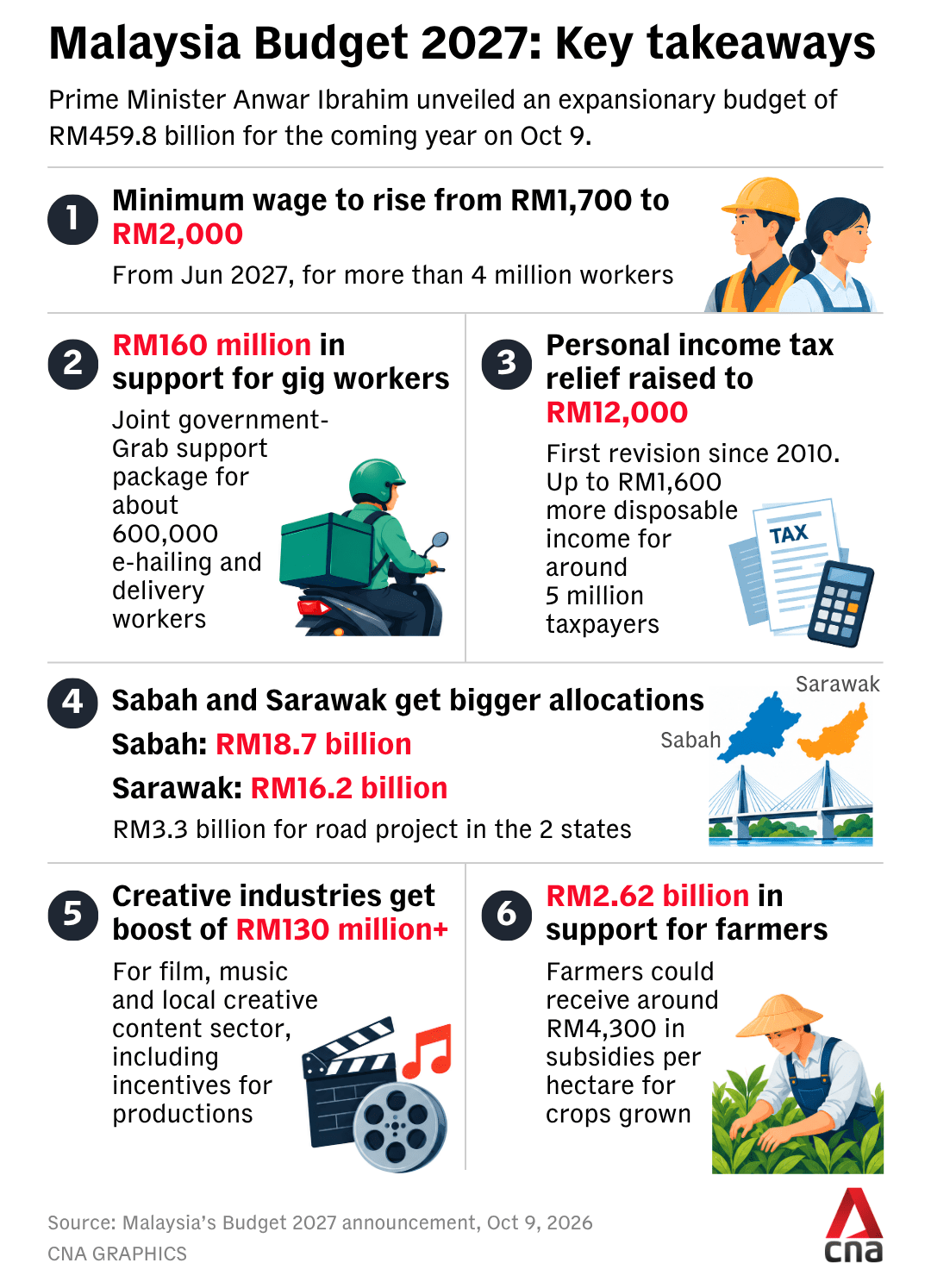
Lower-income households will receive more cash assistance, middle-income taxpayers get tax cuts, while additional support has been extended to civil servants, pensioners, students, gig workers, farmers, fishermen and small businesses.
Azmi Hassan, a senior fellow at the Nusantara Academy for Strategic Research, pointed to the wide “breadth of beneficiaries”, saying the government had sought to reach groups that previously fell through the cracks.
Gig workers, for instance, have long grappled with stagnant incomes and gaps in social protection, he said. Budget 2027 includes measures to raise their earnings and subsidise social security and retirement contributions.
“Anwar is pushing for better wages for them, as well as everyone else in the lower- and middle-income groups,” Azmi told CNA.
The most widely distributed benefits come through the government’s STR and SARA financial assistance programmes. Their allocation will rise from RM15 billion (US$3.67 billion) this year to RM16 billion in 2027, with up to nine million STR recipients eligible for as much as RM150 a month in SARA assistance.
These two initiatives are direct cash aid programmes introduced under the Madani government framework to help Malaysians manage the cost of living.
Workers will also see Malaysia’s minimum wage rise from RM1,700 to RM2,000 a month from June, although smaller businesses are exempted.
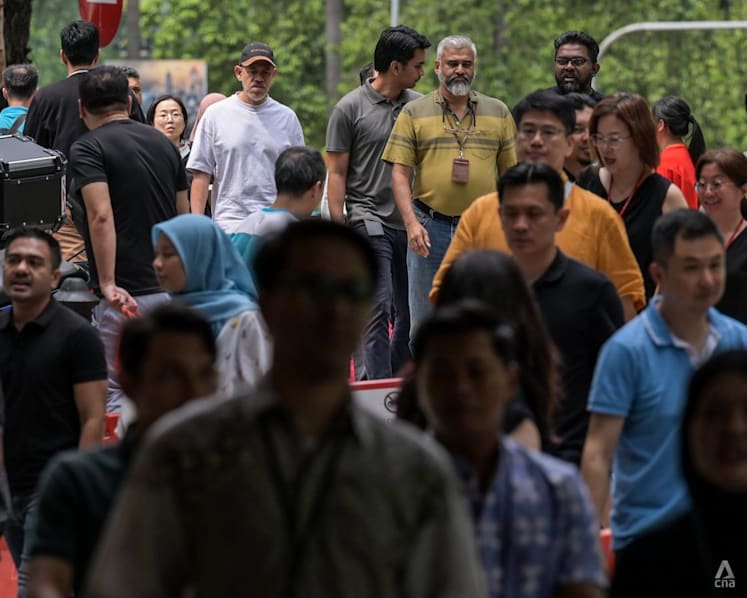 Office workers in Kuala Lumpur. (Photo: CNA/Fadza Ishak)
Not all economists were convinced, however, that spreading the benefits widely would translate into a significant political boost.
Geoffrey Williams, director of Williams Business Consultancy, described the announcements as “rather lacklustre” given the possibility of an early general election.
“Overall this is not a populist budget ahead of GE16 and looks like a missed opportunity in terms of gaining voter support,” Williams told CNA.
He argued that some of the headline measures had already been anticipated, including the increase in the minimum wage, while the RM1 billion increase in STR and SARA funding was unlikely to make a substantial difference to individual households.
“It was a rather ordinary work-a-day budget with no ‘wow factor’,” he said.
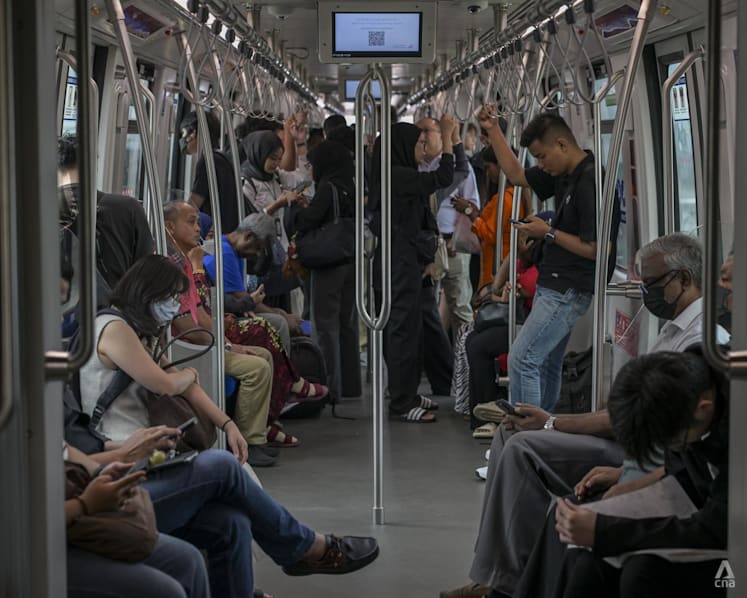 Commuters inside a train in Kuala Lumpur on Sep 7, 2026. (Photo: CNA/Fadza Ishak)
Williams argued that Anwar could have gone considerably further if his objective was to make a decisive pitch to voters. He cited the possibility of writing off student-loan repayments from the National Higher Education Fund Corporation (PTPTN) rather than merely deferring them for borrowers earning up to RM2,500 a month, as announced in the budget.
PTPTN is an authority responsible for giving study loans to students pursuing tertiary education in Malaysia.
Williams also pointed to the possibility of introducing a universal basic pension rather than relying on more targeted assistance for retirees.
Economist Sedek similarly said that while the budget could help narrow the gap between the government’s reform narrative and Malaysians’ lived economic experience, it was unlikely to close it altogether.
“What is important is that some announcements have a strong feel factor, with tangible benefits and implementation starting as early as next week,” Sedek said.
He pointed to the RM1,000 one-off payment for 38,000 taxi and hire-car drivers and 15,000 school bus drivers, which Anwar said would be distributed in the week following the budget.
FISCAL DISCIPLINE NOT ABANDONED
For all the additional assistance, Anwar has stopped short of opening the fiscal taps ahead of an anticipated general election.
Malaysia is projected to spend more next year while simultaneously reducing its budget deficit – a combination the government will point to in rebutting accusations that the 2027 budget amounts to fiscal populism, economists said.
The fiscal deficit is projected to narrow to 3.3 per cent of gross domestic product (GDP) in 2027, from an estimated 3.6 per cent this year. That continues a downward trajectory from 5.5 per cent when Anwar's government came to power in 2022, and puts Malaysia closer to its target of bringing the deficit down to 3 per cent by 2028.
The government also expects federal debt as a share of the economy to decline, from 65.2 per cent of GDP in 2025 to 64 per cent this year and 63.7 per cent in 2027.
Azmi said that Anwar's decision to increase spending without projecting a wider deficit was “sensible”.
“He has managed to dish out election goodies without going overboard (with the spending),” he said.
He added that part of the government's calculation rests on higher revenue. Federal revenue is projected to increase from RM363.6 billion in 2026 to RM380.8 billion next year, providing additional room for spending even as the deficit narrows.
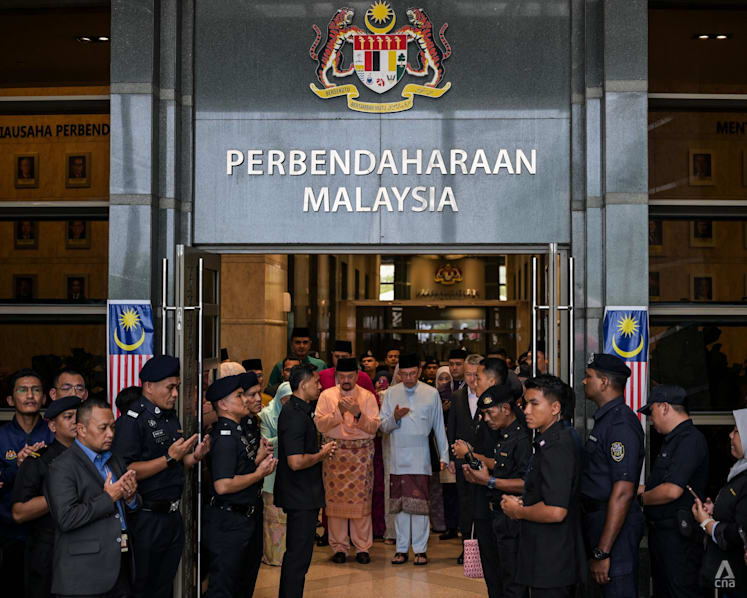 Malaysia Prime Minister Anwar Ibrahim (in blue) , who is also the finance minister, reciting prayers at the door of the Ministry of Finance office in Putrajaya before leaving for Parliament to table the 2027 budget on Oct 9, 2026. (Photo: CNA/Fadza Ishak)
Lee Heng Guie, executive director of the Socio-Economic Research Centre, said the figures showed that the government had maintained its commitment to fiscal consolidation even as it increased assistance to households and spending intended to support economic growth.
“We are reassured by the government's continued commitment to fiscal discipline without sacrificing social and growth priorities,” he told CNA.
Lee noted that 2027 would mark the sixth consecutive year in which the deficit has narrowed. A steady reduction in the deficit and a stable debt trajectory would help strengthen confidence among international investors and credit rating agencies, he stressed, while rebuilding the fiscal buffers Malaysia may need to respond to future economic shocks.
MALAYSIA TO CONTINUE COURTING INTERNATIONAL INVESTORS
Analysts were also encouraged that despite the budget’s focus on domestic concerns, Anwar devoted part of his speech to signalling that Malaysia remains open to investment and is focused on moving into higher-value industries.
Central to that strategy is the Johor-Singapore Special Economic Zone (JS-SEZ), which Anwar said recorded RM132 billion in investments between 2025 and June this year. Anwar and Singapore Prime Minister Lawrence Wong are expected to launch its master plan and blueprint by year-end, as both countries deepen cross-border economic ties.
Beyond the JS-SEZ, Anwar announced initiatives aimed at strengthening industries including semiconductors, artificial intelligence (AI), aerospace, renewable energy and advanced manufacturing, as Malaysia seeks to create more highly skilled and better-paying jobs.
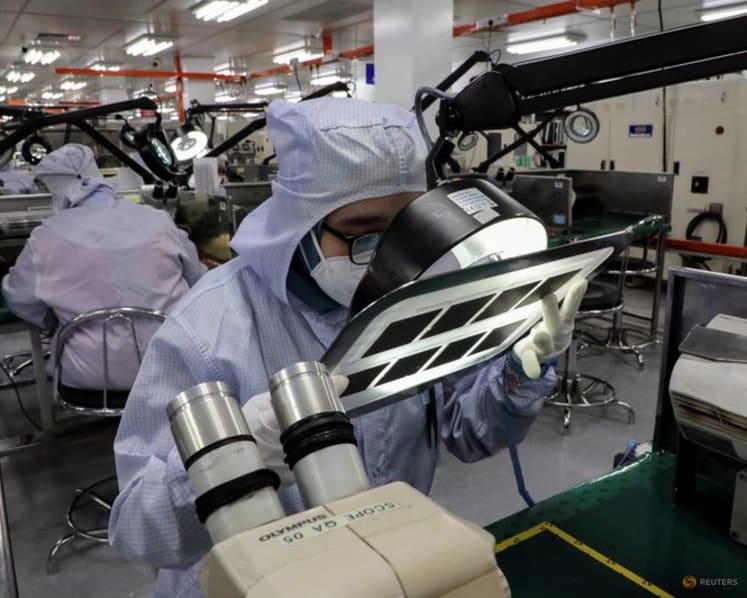 A worker inspecting semiconductor chips at a chip packaging firm in Malaysia in 2021. (File photo: Reuters/Lim Huey Teng)
Sedek said the measures collectively “strengthen Malaysia’s appeal to multinationals”.
“A sovereign AI cloud could support domestic AI capabilities, while the JS-SEZ could combine Singapore’s capital and business networks with Johor’s industrial capacity,” he said.
“Semiconductor investment could also help Malaysia capture more value from its existing manufacturing base.”
Azmi said the announcements showed that Anwar recognised foreign investment as an important part of improving Malaysians’ living standards over the longer term.
“He recognises that it means better-paying jobs, and more disposable income for Malaysians,” he said.
“It’s a two-pronged approach – give Malaysians more assistance, but at the same time offer more higher-paying jobs.”






 English (US) ·