


 4 months ago
166
4 months ago
166
ADVERTISE HERE
Speaking at a Pakatan Harapan (PH) convention, PM Anwar Ibrahim suggested that Barisan Nasional’s announcement that it would go solo in contesting upcoming Johor state polls was akin to threats that could amount to “betrayal” to their unity government partnership.
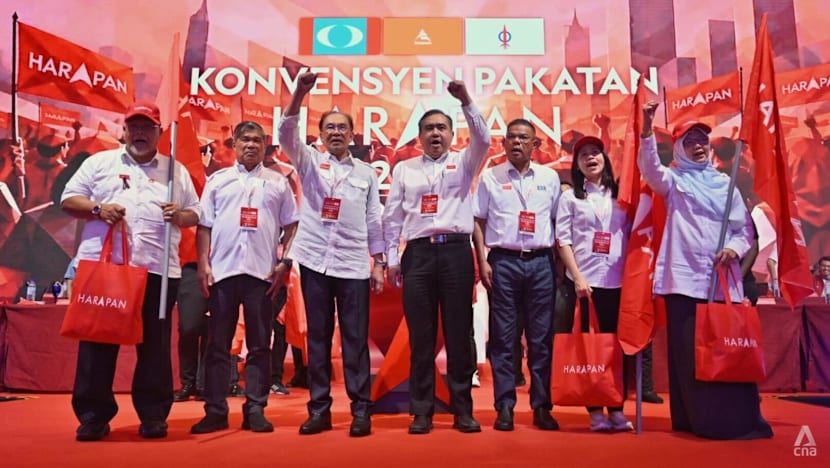
Amanah president Mohamad Sabu, PKR president Anwar Ibrahim and DAP secretary-general Anthony Loke launch the Pakatan Harapan state election machinery and hand over the state election kit during the Pakatan Harapan 2026 Convention at the Johor International Convention Centre in Johor Bahru on May 17, 2026. (Photo: CNA/Zamzahuri Abas)
New: You can now listen to articles.

This audio is generated by an AI tool.

JOHOR BAHRU: Malaysia Prime Minister Anwar Ibrahim said that he is considering calling a general election in the near term, after Barisan Nasional (BN) - a partner in his unity government - announced its intention to go solo in the upcoming Johor state elections.
Delivering a keynote address at a convention in Johor Bahru on Sunday (May 17) by his Pakatan Harapan (PH) coalition, Anwar said that he is “not surprised” by BN’s announcement.
But he added that if BN decides to not collaborate in Johor, PH is ready to also contest all state poll seats not only in the southern state, but also in Negeri Sembilan, Selangor, Penang and Pahang - as well as potentially call for a snap general election.
“Now we are hearing that UMNO and Barisan Nasional intend to contest all seats (in Johor). I am not surprised. But if they choose confrontation in Johor, then our answer must also be firm,” said Anwar, who is also PH chairman.
“If they negotiate properly, we will remain patient and wise. But if they choose war - then we will fight seriously. In the near future, I will call Pakatan Harapan leaders to discuss whether we should consider a nationwide general election,” he added.
PH is made up of Anwar’s Parti Keadilan Rakyat (PKR), the Democratic Action Party (DAP), Parti Amanah Negara (Amanah) as well as other small component parties.
It is the main coalition in Malaysia’s unity government, which also consists of BN, Gabungan Parti Sarawak (GPS) and Gabungan Rakyat Sabah (GRS), among other parties.
Sunday’s convention was attended by around 5,000 delegates and party leaders.
A day before, Johor Chief Minister Onn Hafiz Ghazi said that BN will contest all 56 seats in the upcoming state polls, meaning that it will go it alone and not cooperate with any political pacts.
While PH and BN are partners in the federal unity government, there is increasing talk that the latter is keen to contest solo in state and federal seats in the next general election.
In a recent interview, BN chairman Ahmad Zahid Hamidi said: “In the coming election, I am almost certain we will go solo. But we should not dismiss the need for an understanding with other party coalitions."
However in his speech on Sunday, Anwar suggested that the move to contest alone in Johor, without collaborating with PH, was akin to threats that could amount to “betrayal” to their unity government partnership.
He said that he has taken a “constructive approach” in governing Malaysia, with even states controlled by the opposition treated “according to constitutional spirit”, but this does not mean PH is weak.
“Do not threaten us or move toward betrayal,” he said.
“That is why I agree with the suggestion: if they truly believe the time has come in certain states - in Johor, Negeri Sembilan - then perhaps we should return the mandate to the people and let (them) decide,” said Anwar.
“If the unity government is truly considered tired and exhausted, then let us return to the people - not only in Johor and Negeri Sembilan, but throughout the country. I am ready.”
“This is reformist blood. We do not back down from challenges,” he added.
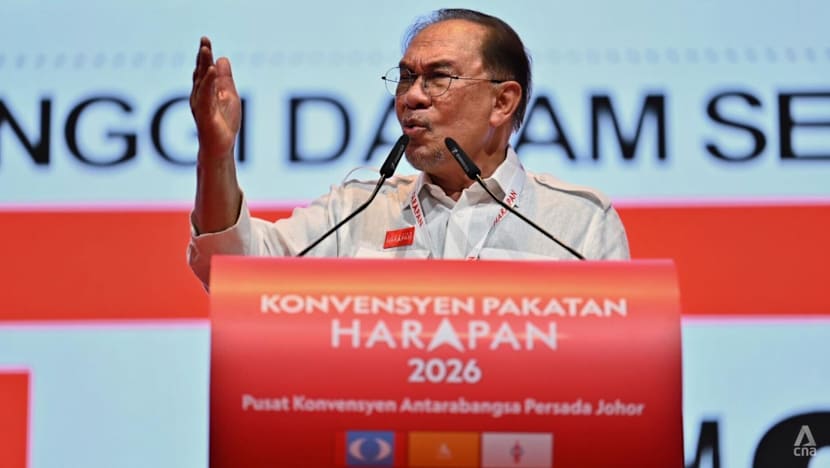 PKR president Anwar Ibrahim delivers a speech during the Pakatan Harapan 2026 Convention at the Johor International Convention Centre in Johor Bahru on May 17, 2026. (Photo: CNA/Zamzahuri Abas)
PH “READY TO FIGHT”, SAYS ANWAR
Anwar also highlighted that PH has “made adjustments” to its pace of making national reforms in consideration of its partnership with BN to preserve government stability.
“We listen. We make adjustments. Some programmes had to be delayed after considering all views. If reform were to move at full speed, many things should have already been done. But sometimes we move carefully because we want strength to remain solid, and we want the government to stay stable,” said Anwar.
“Politics must be stable. The country must remain peaceful. This requires collective strength. There is no reason for us to split apart - unless we are betrayed,” added the PKR president.
Anwar also said that PH had never broken political partnership pacts, even when PKR and DAP were allies with islamist party Parti Islam Se-Malaysia (PAS) under the Pakatan Rakyat coalition from 2008 to 2015.
“If there are people who want to launch a war against us, we are ready to fight. But we will act wisely. That is why, throughout more than three years under (PAS president Abdul Hadi Awang)’s era, we have never incited betrayal against our friends in Pakatan Harapan, nor against our partners in the unity government,” said Anwar.
After the last General Elections in 2022, results led to a hung parliament with no coalition having sufficient numbers to secure a simple majority. Anwar was sworn in as the new prime minister after securing the support of BN and other blocs in East Malaysia.
Since then, BN and PH have worked together in by-elections as well as in state elections.
However, the ties between the two coalitions have been strained recently when 14 United Malays National Organisation (UMNO) assemblymen in Negeri Sembilan withdrew their support in April for chief minister Aminuddin Harun over his handling of a crisis involving the state’s monarchy.
Aminuddin is vice-president of PKR, a key component party for PH, while UMNO is the lynchpin party for BN.
Furthermore, the two coalitions have been trading barbs in Johor over electoral issues such as BN’s move to pass a Bill in the state assembly to appoint five non-elected assemblymen as well as PH’s call for redelineation of electoral boundaries in seats with a high number of voters.
In addition, UMNO president Ahmad Zahid Hamidi has proposed a grand collaboration of Malay-Islamic parties, which observers say indicates a willingness for UMNO to forge ties with the likes of PAS - which is now in the federal opposition - to form the next government.
In his speech, Anwar also highlighted some of the achievements under his government, including sustained economic growth, historic high investments, lower unemployment and inflation as well as progress in reformasi principles.
“Sometimes even our own friends are too busy responding to (political) attacks that they forget to explain what has actually been done.
“Programmes to eradicate poverty, attract investments, curb inflation, reduce unemployment, expand training - all of these achievements surpass previous years,” he added.
The PH convention on Sunday is the coalition’s first in four years, and is typically held ahead of a general election.
PH communications director Fahmi Fadzil earlier said that the event will be the “first beating of war drums” for the coalition, with Anwar’s keynote address set to showcase “a clearer picture of PH’s direction” amid speculation over possible state polls in Johor and Melaka.
Malaysia’s 16th general election must be held by February 2028, though there is speculation that it could be held as early as this year.
However, PH communications director Fahmi earlier told reporters that Anwar has yet to signal if the polls would be held in the near future, as the government remained focused on resolving national issues.
Some media reports have said that the timing of the general election could be dependent on the government’s decision to cut fuel subsidies amid the global energy crunch, and snap polls may be called in October provided his government is not forced to trim subsidies before then.
However, there is also intensifying speculation that BN is set to call for early state polls both in Johor and Melaka. Johor’s state election is only due by mid-2027 while Melaka’s is due by early 2027.
Political analysts said BN has a strong incentive to call early state polls rather than align them with the next general election, as lower turnout in standalone contests tend to favour the incumbent while putting its main rival, PH, at a disadvantage.
Although BN is aligned with PH at the federal level, they are rivals at the state level in Johor and Melaka.
Holding the elections sooner would also allow UMNO to exploit what observers describe as a period of softer support for PH, denying Anwar’s coalition a chance to regroup ahead of national polls due by February 2028.
Recent media reports cite an internal PKR analysis indicating vulnerabilities across many of the party’s seats, including Anwar’s own constituency of Tambun. A significant number of seats the party hopes to contest are also reportedly classified as difficult or competitive.
ANWAR’S GE THREAT, PLEDGE TO GO SOLO JUST “POLITICAL RHETORIC”: ANALYSTS
Analysts told CNA that Anwar saying that he is considering calling for a general election in the near term, and PH’s pledge to contest all the seats in five states without BN, is likely a political strategy and posturing ahead of subsequent negotiations between the two coalitions.
Political analyst James Chin said that the context of Anwar’s remarks at PH’s convention, designed to “light a fire in the bellies of his supporters” must be taken into consideration.
“Calling a general election is best done with the element of surprise (for your opponents) so I think we can take what he said with a grain of salt,” said Chin, who is professor of Asian Studies at the University of Tasmania.
“There are reports of PKR seats being marginal and up for grabs, the timing is not suitable for Anwar also because of the middle east crisis triggering fuel subsidies concerns (for Malaysians),” he added.
Azmi Hassan, a senior fellow at the Malaysia-based think-tank Nusantara Academy for Strategic Research, echoed similar sentiments, noting that it is strategically unlikely for the two coalitions to not collaborate, especially at the federal level and at states like Perak and Pahang, where contests will be stiff against the main opposition bloc Perikatan Nasional (PN).
“The call to go solo seems like political rhetoric. Whatever is being said at these conventions, they’re just negotiation tactics to signal an extreme stand for discussions,” said Azmi.
“It does not mean that they pledge to go solo (for these state polls), there will be no cooperation between BN and PH at the federal level. Even in these state seats there will be compromise on (quality of candidates they field) etc,” he added.
He posited that Anwar is also unlikely to call a general election unless his unity government has collapsed at the federal level.
“(BN’s Ahmad) Zahid has said he will ensure the unity government stays intact until a General Election is called. It is not the right time for Anwar now,” he added.
Speaking to reporters later on Sunday evening, Anwar said that he intends to meet his BN counterpart Ahmad Zahid for talks to discuss its decision to contest Johor on its own.
“We want to help and rectify the situation if there were any mistakes made. We understand if there was a misunderstanding, there will be disputes," Anwar reportedly said.




 English (US) ·