


 7 months ago
108
7 months ago
108
ADVERTISE HERE
KUALA LUMPUR: Two opposing legal suits filed in the Federal Court by national oil corporation Petroliam Nasional Bhd (Petronas) and the Sarawak state government over hydrocarbon resource ownership have cast a long shadow over long-assumed understandings of federal power in Malaysia.
Analysts note that the filings — Petronas' on Jan 10 and Sarawak's on Feb 23 — represent not merely a corporate-regulatory dispute but the most serious federal constitutional test since Malaysia's formation in 1963.
"At this stage, the situation does not amount to a constitutional crisis in the classical sense, but it does constitute a significant constitutional stress test with clear political implications," said Samirul Ariff Othman of Global Asia Consulting and a lecturer at Universiti Teknologi Petronas.
Jamil Ghani, a doctoral candidate at Singapore's S Rajaratnam School of International Studies, said the Federal Court's ruling will have serious implications for Prime Minister Anwar Ibrahim's government and the country's economic stability.
"A clear and definitive ruling could resolve longstanding ambiguities over federal-state legal boundaries in oil and gas governance. However, if the court adopts a narrow interpretation or leaves room for further contestation, it may instead formalise competing legal claims and prolong uncertainty," he told CNA.
Samirul added: "The issues before the court are serious because they would have implications well beyond the oil and gas sector, potentially prompting renewed assertions of state authority and reopening long-assumed understandings of federal power."
THE DISPUTE
Both parties’ turn to the Federal Court represents the latest twist to a saga that goes back to July 2024, when Petronas and the Sarawak state government began talks over the latter's claim for greater autonomy over its hydrocarbon reserves.
The core dispute is Sarawak's challenge to the constitutional foundation of Petronas' monopoly over the country's hydrocarbon reserves that is stipulated under the Petroleum Development Act (PDA) enacted in 1974.
The state government, through its wholly owned Petroleum Sarawak Bhd (Petros), is demanding regulatory control over the hydrocarbon reserves within its own territory — both onshore and offshore Borneo island.
Petronas is seeking judicial clarity from the Federal Court regarding the regulatory framework governing its upstream and downstream operations in Sarawak. The national oil corporation also wants the court to determine whether it must comply with state mining laws or if the PDA overrides state legislation.
Its case is scheduled for a hearing on Mar 16.
Sarawak, in a nutshell, wants the Federal Court to determine the validity of three federal laws — the PDA, the Continental Shelf Act (1966), and the Petroleum Mining Act (1966) — that the state government is arguing adversely affect and deprive the state of its rights to its natural resources.
No hearing dates have been set for Sarawak's legal challenge.
“What Sarawak is asking would declare the PDA invalid, destroy Petronas, and open Malaysia to overlapping territorial claims with countries like the Philippines if the Continental Shelf Act is deemed invalid and does not apply to the state," noted Azmi Hassan, a fellow at the Nusantara Academy for Strategic Research.
CHALLENGE TO FEDERAL STRUCTURE
The Sarawak-Petronas spat is a serious challenge to Malaysia's federal structure, which combines a constitutional monarchy with a parliamentary democracy, distributing powers between the federal government and 13 states, along with three federal territories, noted analysts.
 Sarawak wants its own Petros (Petroleum Sarawak Berhad) to replace Petronas as the prime mover in the state's oil and gas sector. (Photo: CNA/Fadza Ishak)
The quarrel also carries serious ramifications for the national economy, with an annual gross domestic product (GDP) of roughly US$420 billion.
Losing any regulatory control over Sarawak — where over 60 per cent of Malaysia's natural gas is located — would be devastating for Petronas, which is already grappling with industry-wide headwinds of weak global oil prices and lower-quality oil fields in more difficult geological locations that are hurting its bottom line.
Sarawak has probable and proven reserves of petroleum representing 60.87 per cent of Malaysia's total reserves, and the state accounts for 90 per cent of Malaysia's liquefied natural gas (LNG) exports that make up a large portion of the oil corporation's earnings.
As the sole custodian of the national hydrocarbon reserves, Petronas plays a central role in the national economy.
For the financial year ending December 2025, Petronas reported total revenue of RM266.1 billion, a 17-per-cent decline from the previous year. Net profit also fell to RM45.4 billion, down 18 per cent from the previous year, the company announced on Feb 27.
In October 2025, the government announced that it expected to receive a dividend payment of RM20 billion from the national oil corporation this year. The payout forecast, down from RM32 billion the government received in 2025, is set to be the lowest amount received since 2017.
All of this sustains the country's civil service of close to 1.7 million employees and other government programmes, particularly those related to affirmative action policies for the country's politically dominant ethnic Malays.
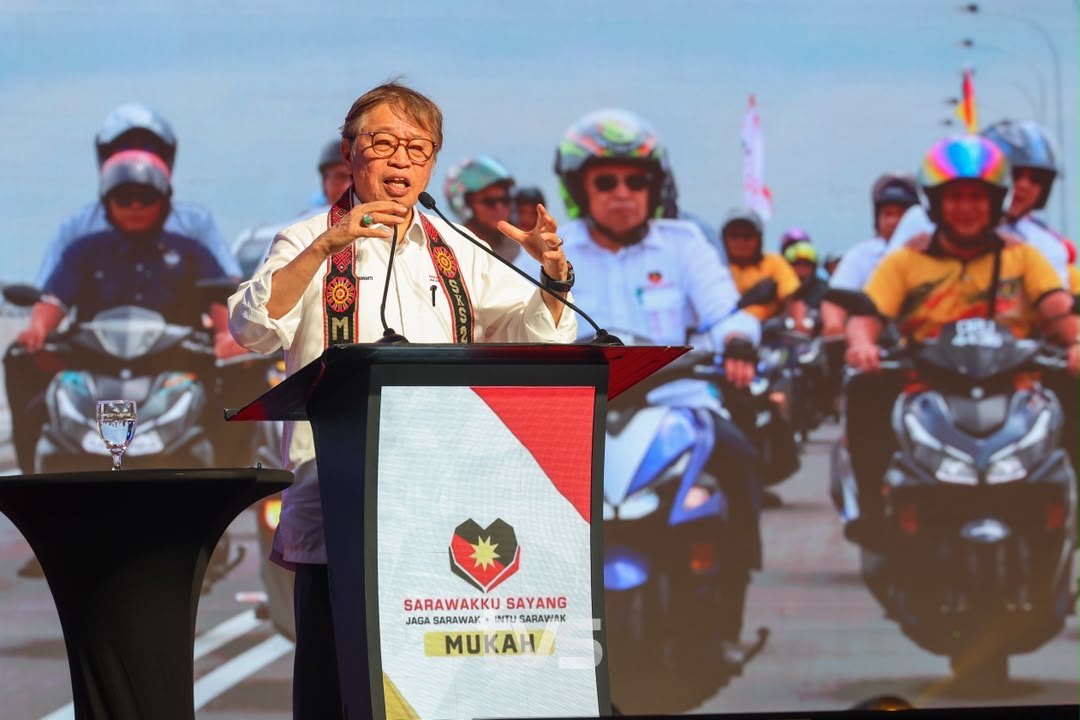
 Malaysian Prime Minister Anwar Ibrahim (left) and Sarawak Premier Abang Johari Openg inked a joint declaration involving oil and gas operators Petronas and Petros on May 21, 2025. (Photo: Izzuddin Abd Radzak/Malaysia PMO)
WHAT'S AT STAKE FOR PETRONAS, ANWAR
Petronas is more than just the custodian for the nation's hydrocarbon reserves.
One of its most crucial roles is that of the so-called "central aggregator" of the country's natural gas sector.
Essentially, Petronas enjoys the sole designation as the single buyer, or aggregator, for all gas produced domestically and imported LNG. It pools these gas supplies and sells them to power producers, industries, and other consumers under regulated terms.
Oil industry analysts estimate that this role as an aggregator, which also acts as a price stabilisation mechanism, earns the national oil corporation roughly RM10 billion annually.
It is a slice of this huge source of revenue that Sarawak is eyeing, industry analysts noted.
The decision by both Sarawak and Petronas to seek judicial redress to settle their years-long dispute over hydrocarbon ownership also represents a political setback for PM Anwar.
In May 2025, Anwar declared that his government had reached a pact with the Sarawak state government headed by Premier Abang Johari Openg, where both Petronas and Petros would jointly develop the country's oil and gas sector.
But in reality, the impasse between the two parties only worsened, Petronas officials privately acknowledged to CNA.
"The perception with Petronas heading to the courts first is that the national oil corporation would have got the go-ahead from Anwar," said Azmi, adding that the pressure is now on the prime minister to take another stab at resolving the spat before the court hearings begin.
The respondents for Petronas' Federal Court motion are the federal government and the Sarawak state government, Petronas said in a statement on Jan 12.
Petronas' motion is to ensure the company continues to operate in full compliance with applicable laws and sound governance practices, it added. "It is not intended to challenge Sarawak’s development aspirations or hinder the role of (Petros) in the state’s energy sector."
Samirul of Global Asia Consulting sees it slightly differently.
"For Anwar's government, this episode represents less of a crisis than a moment of reckoning. It is a test of how Malaysia chooses to resolve profound federal questions through law, rather than through political force or improvisation," he said.
SARAWAK'S LEGAL STRATEGY
"By escalating the matter to the apex court, Sarawak is institutionalising the dispute through constitutional channels rather than relying solely on political negotiation. The outcome could recalibrate the balance of authority between Putrajaya and resource-rich states," noted Jamil.
Malaysia’s other states with hydrocarbon reserves are Terengganu and Kelantan.
Samirul said Sarawak's legal gambit showed shrewd judgment and foresight.
"By initiating constitutional action rather than remaining in a purely responsive posture, Sarawak has repositioned itself from defensive respondent to agenda-setting litigant," he said.
"This enables Sarawak to frame the dispute as concerning constitutional validity and historical rights grounded in the 1963 agreement rather than as a narrower regulatory disagreement over licensing or operational compliance," Samirul added.
He was referring to the Malaysia Agreement 1963 - when Sarawak and Sabah joined the federation - that grants the two North Borneo states specific rights and autonomy, including greater control over the management of their natural resource.
Analysts also noted that Sarawak’s move to turn to the courts is a demonstration to the state’s electorate that the state safeguarding its autonomy through institutional channels.
“Sarawak’s move constitutes a deliberate consolidation strategy — legal, political, and symbolic — designed to redefine the terms on which future centre-state relations over petroleum resources will be negotiated,” Samirul said.






 English (US) ·