


 9 months ago
153
9 months ago
153
ADVERTISE HERE
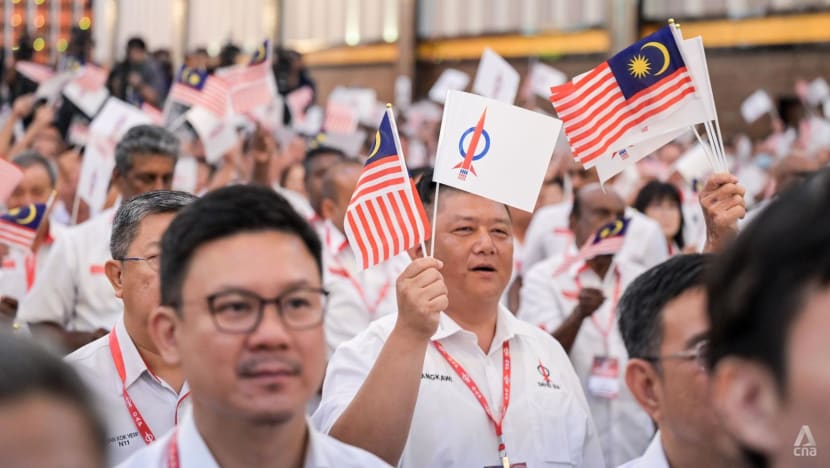
DAP members at the party's 18th national congress in Shah Alam, Selangor on Mar 16, 2025. (Photo: CNA/Fadza Ishak)
New: You can now listen to articles.

This audio is generated by an AI tool.

KUALA LUMPUR: Malaysia’s Democratic Action Party (DAP) may be in the ruling Pakatan Harapan (PH) coalition but in the past few weeks, its leaders have issued a series of bold demands, publicly pushing the very government they are part of.
Chief among these is the controversial call to recognise the Unified Examination Certificate (UEC) that is awarded by independent Chinese-medium schools.
Currently, the UEC is recognised by many top international universities and local private colleges but is not recognised by the government for entry into public universities or the civil service, meaning those who have obtained the UEC are not eligible for those institutions on that alone.
DAP's push met immediate resistance from the United Malays National Organisation (UMNO), a partner in the unity government helmed by Prime Minister Anwar Ibrahim.
The Federation of Malaysian Islamic Students (GAMIS) - a non governmental organisation - also submitted a memorandum at the DAP’s Kuala Lumpur headquarters. The federation described DAP’s call as “a step backwards” in Malaysia’s education reform.
Some analysts interpreted DAP’s move as an attempt to reassure its core Chinese base that the party has not abandoned its ideological commitments — prompted by its recent drubbing in the Sabah state polls that were held on Nov 29.
Besides that, Digital Minister Gobind Singh Deo - who is DAP chairman - has criticised the police over a dress-code incident in Melaka, while former deputy law minister Ramkarpal Singh renewed called for the total abolishment of the SOSMA security law.
Notably, DAP secretary-general Anthony Loke also said in an interview with a Chinese language Youtube channel “The Keywords” that the party would reassess its role in the government if Anwar failed to deliver meaningful reforms within the next six months.
He however said that DAP would not withdraw support for the administration and risk political turmoil.
“After six months, whatever decision we make, we’ve already informed the prime minister that we will not withdraw our support for him, at least until the next general election,” Loke was quoted as saying by local news platform Malaysiakini.
“How we move forward, how we contest, how we prepare for the next general election - these will be discussed later.”
With 40 parliamentary seats in the 222-member lower house, DAP supplies the most seats to Anwar’s unity government made up of various coalitions besides PH.
However, former DAP Member of Parliament Ong Kian Ming told CNA that the party is facing a “crisis of confidence” not seen in decades.
“The party faces the real possibility that it could lose a significant chunk of support from its Chinese supporters in Peninsular Malaysia and Sarawak either through not coming out to vote or coming out to vote for ‘anyone but the DAP’,” said Ong, a former Deputy Minister of International Trade and Industry who is now an adjunct professor with Taylor’s University.
“DAP’s traditional urban voter base sees the party as someone who has been unfaithful in a marriage … ‘betrayed the voters' trust’ but has not yet divorced the party,” added Ong.
The timing of DAP’s demands — so soon after the Sabah electoral loss — has raised eyebrows among some experts.
In the 2020 Sabah election, the PH component party secured six seats out of seven it contested, some with super-majorities.
This time, however, it lost all eight seats it contested.
For a party that has long relied largely on unwavering backing by the Chinese urban electorate, the psychological blow was severe, triggering the vocal response from its leadership, said observers.
Despite the internal alarm in DAP, some analysts told CNA the party may be panicking for the wrong reasons, arguing that the localised results in Sabah do not necessarily signal a wholesale abandonment by the national electorate.
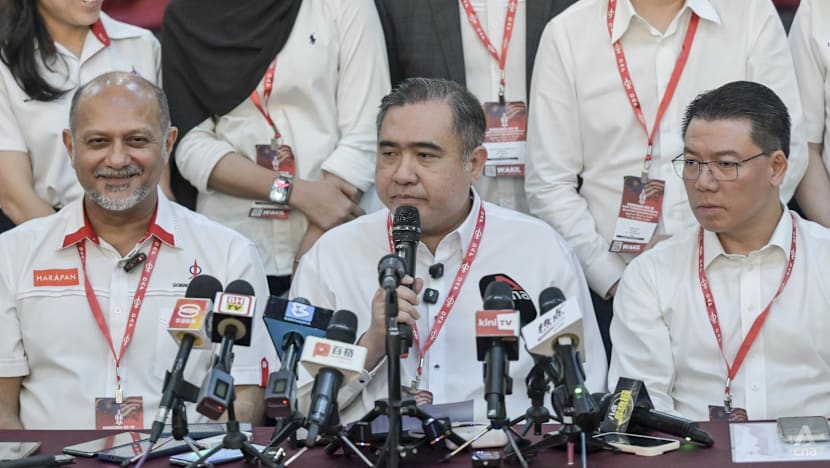 DAP secretary-general Anthony Loke (centre), chairman Gobind Singh Deo (left), and deputy chairman Nga Kor Ming (right), speak at a press conference in Shah Alam on Mar 16, 2025, after the party’s central executive committee elections. Photo: CNA/Fadza Ishak)
A “STRANGE AND WRONG MOVE”?
DAP leaders have been vocal recently about the need for reforms by the Anwar government.
Deputy chairman Nga Kor Ming who is Housing and Local Government Minister was reported to have said on Dec 7 that he planned to meet Anwar over UEC recognition.
While UEC is an issue that DAP has long pursued, it had not made the news for some time until Nga’s comments, which drew sharp reactions from various Malay-based political parties such as UMNO and the opposition’s Parti-Islam Se-Malaysia (PAS).
Meanwhile, Gobind urged the Inspector-General of Police Khalid Ismail to issue a clear directive to police stations nationwide not to refuse victims or complainants the right to report an accident or crime due to their attire.
The latter came after two women were reportedly barred from entering the Jasin police headquarters in Melaka on Dec 8 because of clothing deemed "inappropriate" for a government building.
Bagan MP Lim Guan Eng, who now serves as the DAP national adviser, had submitted a 10-point letter to Anwar, dated Dec 8, and made public on Dec 12, urging Anwar to fulfil the coalition's election manifesto promises and begin defending the rights of its core supporters more aggressively.
He said that these 10 critical areas — mainly economic matters — were essential to addressing a growing "trust deficit" among the public toward the administration.
Ong said it was not surprising that some leaders in the DAP would react strongly to its current situation by turning to certain issues that will appeal to its base.
“This is indeed a calculated risk to put pressure on Prime Minister Anwar to fulfil one of the promises in the Pakatan Harapan Manifesto in 2018,” Ong said about the UEC demands.
PH’s 2018 general election manifesto promised UEC recognition, on the condition that university applicants obtained at least a credit in Malay in the Sijil Pelajaran Malaysia (SPM) examinations, which are equivalent to the O-Levels.
When PH came into power in 2018, it had formed a task force to gather views on the UEC but the effort stalled after a change of government in 2020.
The promise was also included in the PH’s 2022 manifesto.
Political analyst Azmi Hassan of the Nusantara Academy for Strategic Research told CNA that the "manner and timing" of DAP’s recent actions could suggest desperation.
“DAP is perceived to be in a very weak position. Pursuing UEC recognition now, just after a humiliating defeat, looks desperate. They made a very strange and wrong move,” he said.
Ong added that DAP’s public push for UEC was strategically risky.
“A more nuanced and quiet approach of getting consensus within the Cabinet to recognise the UEC as an examination into public universities with a pass in SPM Malay for example but not asking for the UEC to be recognised as an entry into the civil service would have been a compromise which the Cabinet could have deliberated on and agreed upon, within a reasonable time frame,” he said.
Former Health Minister Khairy Jamaluddin posited that DAP’s moves came about as it had entered a state of panic, fearing that the sentiments in Sabah could trigger a spillover effect in Sarawak before eventually reaching Peninsular Malaysia.
He said in his popular Keluar Sekejap podcast that this set the tone for DAP’s top leaders to then launch a coordinated revival of its traditional reformist pillars: Education equality, civil liberties and economic justice.
According to Khairy, DAP would have felt pressured to demonstrate its core identity to ward off accusations of “becoming the next MCA (Malaysia Chinese Association)”, a party whose long-standing role within Barisan Nasional (BN) - a partner coalition in the unity government - has been overshadowed by its perceived subservience to UMNO.
DAP currently holds five full ministerial positions in the Cabinet.
Multi-racial in outlook but predominantly Chinese in composition, it draws much of its support from urban voters in big towns and cities across Malaysia.
“DAP is just merely trying to make the right noises. Both the MCA and Gerakan had been through the same path. Why didn't they (DAP) push for the UEC as part of the requirements to support and participate in the Madani government?,” said independent analyst Khoo Kay Peng.
The Chinese-majority Gerakan, which was formerly a BN party, is now part of the Perikatan Nasional (PN) opposition coalition.
An aide to a DAP minister told CNA on the condition of anonymity that he thought the government has not done enough in terms of reforms - both institutional and economic.
He cited the example of the Malaysian Anti-Corruption Commission, specifically highlighting how Chief Commissioner Azam Baki — once a target of intense criticism and calls for resignation from PH — remains at the helm under the current administration.
“It’s all about political will. But it’s not only DAP that is worried. The other PH parties are worried about the Sabah results as well,” he said.
In response to DAP’s push on the UEC, Anwar had said earlier this month that any matters that touch on religious, racial and ethnic sensitivities must take into account the position of Malay as the national language in the country’s Constitution.
On Wednesday, speaking to editors from local and international media, Anwar said that starting next year, the government would take bolder steps in addressing issues deemed sensitive and controversial, including matters related to enforcement, language, and race.
"I feel the time has come for us to move more boldly, starting next year, on delayed issues considered sensitive or controversial. We must face them with greater firmness and courage, including the effectiveness of enforcement agencies and decisiveness in taking action,” he said, as cited by local news platform Bernama.
He did not specify the exact issues.
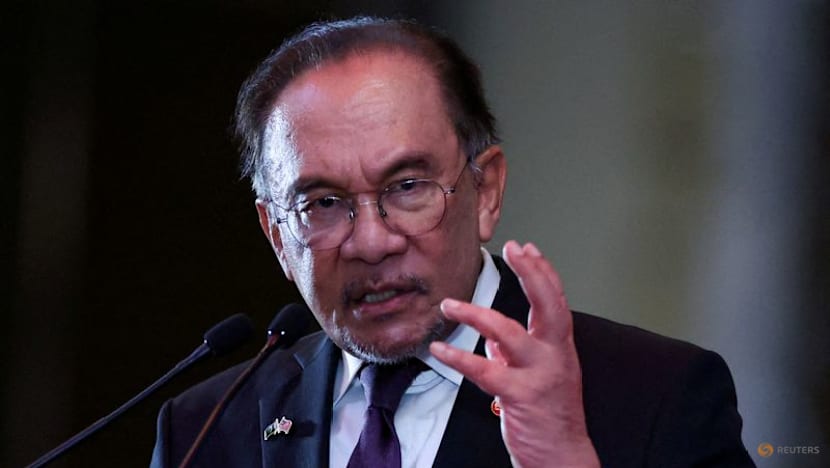 Malaysia's Prime Minister Anwar Ibrahim speaks as he attends a business and investment conference, during Pakistan Prime Minister Shehbaz Sharif's official visit, in Kuala Lumpur, Malaysia, on Oct 6, 2025. (File photo: Reuters/Hasnoor Hussain/Pool)
PANICKING “FOR ALL THE WRONG REASONS”
Some analysts however said that DAP had misread the reasons behind its defeat in Sabah and that its showing was caused by a surge of state nationalism in the state.
James Chin, a professor of Asian studies from the University of Tasmania, said that this sentiment does not exist in the same way in Peninsular Malaysia.
“It’s very much the rise of state nationalism more than anything else. For me DAP panicked for all the wrong reasons,” he said, adding that MCA and Gerakan were unlikely to get the Chinese's support.
Azmi concurred with Chin, saying that unlike voters in Peninsular Malaysia, those in Sabah could turn to regional options like Warisan or Gabungan Rakyat Sabah (GRS) as alternatives to the established parties.
“In Peninsular Malaysia, voters still need to vote for DAP to protect and champion their cause,” he said.
However, observers said that there is a risk of future voter apathy.
“There's a real gap of a good opposition party, a role once played by the DAP. But that doesn't mean they will continue to support the party. There won't be a real enthusiasm to turn out to vote,” Khoo said.
Agreeing, Ong said it was likely that many of the Chinese voters may simply choose not to turn out for the next election rather than to vote for another coalition, especially in Peninsular Malaysia.
DAP HAS TO BE “CLEVER AND CAREFUL"
There is no easy fix for the DAP, as the party is currently trapped in a political Catch-22, said observers.
“One strategy now being quietly floated is for the DAP to distance itself from the unity government without withdrawing parliamentary support for Anwar,” said former diplomat Dennis Ignatius in a blog post on Dec 16.
Chin said the most important thing for DAP is to push Anwar to revive the economy and stop playing the political Islamic card.
“Anwar has been chasing the Malay or Islamic card since coming into power. The Chinese are telling him that there is nothing he can do to win the Malay votes, so why don’t you fix the economy and then the Malays will come back because they can see the economy is doing well,” he said.
Ong meanwhile said that DAP is caught between a rock and a hard place. It would have to get Anwar to agree to certain policy concessions - especially in the areas of institutional and economic reform - but in ways that are broad-based and do not necessarily alienate BN.
This was so that the party could “sell” a narrative to its supporters that it has and can continue to deliver its promises to its supporters.
“There are many ways to do this, but the DAP has to be clever and careful in negotiating these parameters with PM Anwar Ibrahim and this is best done in private rather than in public,” he said.
As part of a Dec 16 Cabinet reshuffle, Anwar reassigned two key DAP figures to different ministerial posts, a move Azmi said was telling.
Hannah Yeoh moved from Youth and Sports Minister to Minister in the Prime Minister's Department (Federal Territories) and Steven Sim switched from Human Resources Minister to become Minister for Entrepreneur Development and Cooperatives.
Nga also retained his Housing and Local Government Minister post.
“It shows that Anwar wants to alleviate DAP and wants to help give a signal to their supporters that DAP is well and alive in Peninsular Malaysia,” said Azmi.
“These three particular portfolios are very close to Chinese interests. It will be up to the three ministers to do the job and the ball is now at their feet,” he added.
Azmi believes that while Anwar is unlikely to feel pressured by DAP, the prime minister recognises that a stable DAP is essential to PH and its electoral prospects.
“Anwar needs a strong DAP, not a weak one because PKR and (moderate Islamic party) Amanah have been supported by DAP supporters during elections.
"A strong DAP will make it easier for them to win elections, but a weak DAP will spell trouble for them, especially when the next general election is of concern,” he added.
Chin however believed that Anwar would likely stop short of a firm promise, simply ‘noting’ the DAP’s demands.
“It is a nice way of saying you can say whatever you want, but I am still the boss and I will do what I want,” he said.





 English (US) ·