


 9 months ago
85
9 months ago
85
ADVERTISE HERE

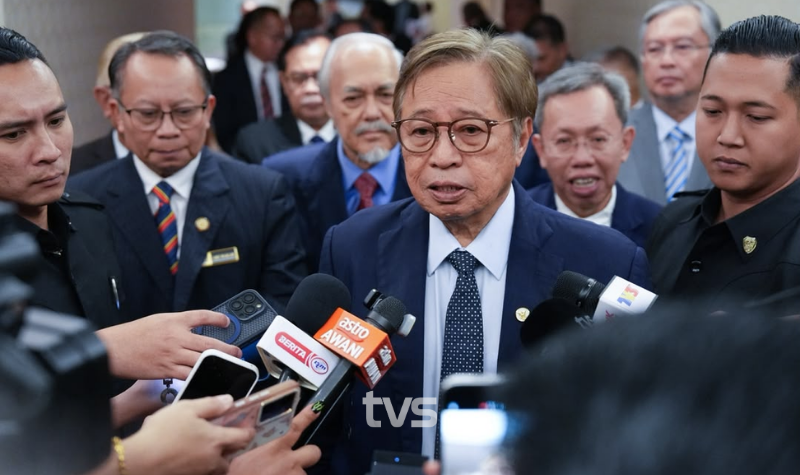
Abang Johari delivers his keynote address titled ‘Water: Driving Sarawak’s Resilient and Sustainable Future’ at IWA Water and Development Congress and Exhibition in Bangkok, Thailand on Tuesday. – Photo from Sarawak Premier’s Office
KUCHING (Dec 9): Sarawak is strengthening its push for full water supply coverage and renewable energy expansion through innovative and practical solutions aligned with the state’s Post Covid-19 Development Strategy 2030 (PCDS 2030), said Premier Datuk Patinggi Tan Sri Abang Johari Tun Openg.
Delivering his keynote address titled ‘Water: Driving Sarawak’s Resilient and Sustainable Future’ at the International Water Association (IWA) Water and Development Congress and Exhibition in Bangkok, Thailand on Tuesday, he said these initiatives aim to support long-term economic growth, social inclusion and environmental sustainability.
He said Sarawak’s vast terrain, scattered settlements and nearly 40 per cent rural population continue to pose challenges in providing reliable water supply systems.
However, he noted that the state has adopted targeted approaches to ensure that remote communities are not left behind.
According to him, Sarawak’s efforts are guided by PCDS 2030, which positions sustainability, inclusivity and innovation at the core of development.
“Through this strategy, Sarawak aspires to become a high-income state where everyone can enjoy economic prosperity, social inclusivity and a sustainable environment,” he said.
Abang Johari said renewable energy remains a key element of this transition, with hydropower from the Batang Ai, Bakun and Murum dams forming the backbone of the state’s clean energy mix.
He said about 62 per cent of Sarawak’s energy currently comes from renewable sources.
“We aim to expand our capacity to 10 gigawatts by 2030 and 15 gigawatts by 2035, securing Sarawak’s energy future and reinforcing our position as the Battery of Asean,” he said, adding that the state’s growing green energy capacity places it in a strong position to support wider regional energy aspirations.
He described water as a new commodity at the heart of Sarawak’s green energy ambitions, from hydropower to hydrogen development.
“Every step we take toward building a sustainable energy future relies on the prudent management and availability of this vital resource,” he said.
He also highlighted the integration of floating solar technology at hydropower reservoirs, where the 50-megawatt floating solar project at Batang Ai is already operational, with plans to expand up to 160 megawatts and introduce similar systems at Bakun and Murum.
Future hydropower development, he said, will be implemented through cascading reservoirs to optimise generation while reducing environmental and social impacts.
On wastewater management, Abang Johari said Sarawak is strengthening both individual and public sewerage systems through environmentally friendly technologies, environmental, social and governance (ESG) principles and modern resource-recovery approaches.
“Innovations such as sludge-to-energy solutions will create self-sustaining systems, turn waste into valuable resources, reduce environmental impact and enhance Sarawak’s resilience and environmental protection efforts,” he said.
Abang Johari also said Sarawak recently launched the Five-Year Development Plan 2026 to 2030 to accelerate implementation, deepen structural transformation and increase private sector participation.
He encouraged industry players and investors to collaborate with Sarawak in advancing sustainable infrastructure development.
“Together, we can bridge gaps, drive economic diversification, strengthen social well-being and build a resilient, prosperous and sustainable future for all Sarawakians,” he said.
Before concluding, Abang Johari announced that Sarawak will host two major international events: the Borneo International Water and Wastewater Exhibition and Conference in 2026 and the IWA World Water Congress and Exhibition in 2028.
He said the conferences will bring together experts, policymakers and industry leaders to address emerging challenges and shape future water governance.


 English (US) ·