


 1 day ago
4
1 day ago
4
ADVERTISE HERE
A toy laptop bought for his younger sibling in the 1990s sparked Ts. Syahrul Nizam Junaini’s lifelong interest in technology – a curiosity that has since evolved into a 25-year career spanning education, digital transformation and emerging technologies.
Today, the Professional Technologist and Senior Lecturer at the Faculty of Computer Science and Information Technology, Universiti Malaysia Sarawak (UNIMAS), is among those encouraging journalists and other professionals to explore artificial intelligence (AI), while remaining firmly in control of the final output.
For Syahrul, the rapid development of AI is not a reason to resist technological change, but a reason to understand it better.
My AI journey
Syahrul’s journey into technology began at home, long before terms such as generative AI, large language models and AI agents became part of everyday conversations.
“At that time, my late father bought a small laptop, a toy laptop for my younger sibling. But I was the one who became interested in it.
“In the 1990s, my father was among the first people in the village to own a PC,” he said.
That early curiosity eventually led him to pursue computer science and build a career in higher education, where he has spent more than two decades teaching, training and exploring technological developments.
Syahrul holds a Master’s degree in Electronic Imaging and Media Communications from the University of Bradford, United Kingdom, as well as a Professional Certificate for Entrepreneurial Educators from University College Dublin and a Professional Certificate in Digital Transformation from Universiti Teknologi Malaysia (UTM).
He is currently pursuing his doctoral studies.
Beyond academia, Syahrul is also an Accredited Consultant Trainer with HRD Corp and has designed and delivered more than 200 training programmes for companies and government agencies.
His areas of expertise have expanded alongside the digital landscape, covering AI, ChatGPT and Large Language Models, digital transformation, data analytics, digital marketing, digital entrepreneurship, product and service innovation, as well as creative and critical thinking.
Recognition
His contributions have also earned him the National Academic Award (AAN) in 2017 and the Sarawak Maal Hijrah Award in 2018.
Despite the qualifications and recognition accumulated over the years, Syahrul said his approach to technology remained rooted in the same curiosity that began with that toy laptop.
“What we learn today will already be outdated tomorrow. The day after tomorrow, there will be new technology, robotics and so on. My interest lies in exploring,” he said.
That mindset has become particularly relevant as AI rapidly moves from specialised research and industrial applications into workplaces, classrooms, newsrooms and everyday life.
Generative AI refers broadly to AI systems capable of producing new content such as text, images, audio, video and computer code in response to user instructions.
Tools powered by large language models (LLMs) can also generate, summarise and transform text within seconds.
Evolving technology
The technology has opened new possibilities for productivity, but its growing accessibility has also raised concerns over accuracy, misinformation, copyright, privacy and the risk of people relying too heavily on machine-generated content.
For Syahrul, the answer is not to avoid AI, but to learn how to use it responsibly.
When asked whether he uses AI more for work or personal purposes, his answer was immediate – personal use.
His message to those who remain hesitant about experimenting with AI is equally straightforward.
“Don’t be afraid, explore it yourself. Even if you make a mistake, the laptop won’t explode. At worst, it will just shut down,” he said.
However, exploration must be accompanied by an understanding of the technology’s limitations, particularly when AI is used for professional work.
This is especially important in journalism, where speed and productivity must be balanced with accuracy, verification and editorial judgement.
Syahrul said journalists should not view AI as a replacement for their core professional skills. Instead, they should combine their understanding of AI tools with fundamental journalism knowledge.
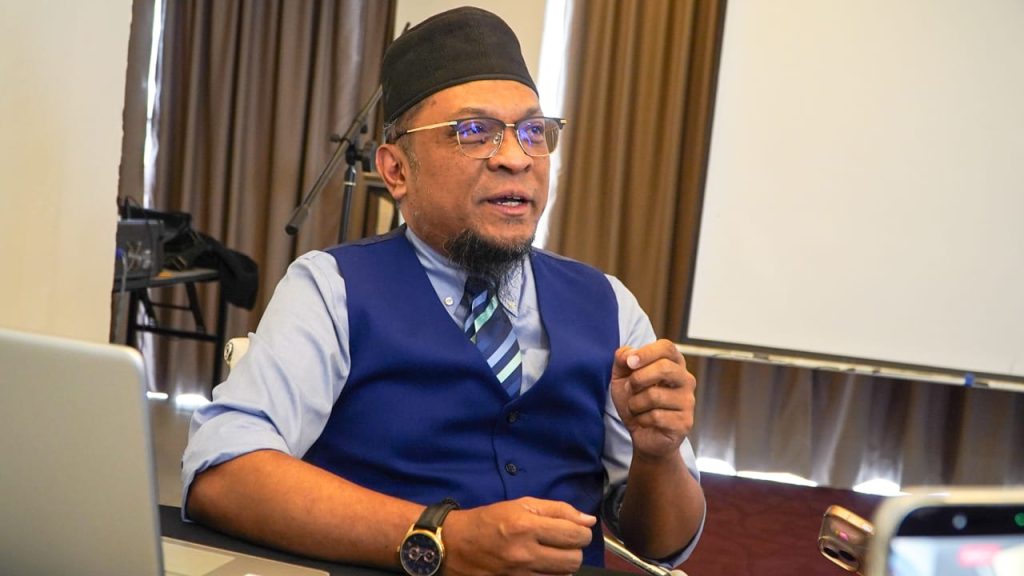 Ts. Syahrul Nizam Junaini, Senior Lecturer at the Faculty of Computer Science and Information Technology, Universiti Malaysia Sarawak (UNIMAS).
Combining journalism with AI skills
“First, you need the skills to master AI tools. Second, you need basic journalism skills. When we combine the two, that is when it becomes solid.
“If we leave it to AI 100 per cent, it will become stiff like a robot. If we use manual skills and writing but do not use AI, then we are losing out and falling behind,” he explained.
He believes AI can significantly improve productivity when used properly, potentially allowing journalists to complete certain tasks two or three times faster.
But productivity, he stressed, should never be allowed to compromise accuracy.
One of the most important issues journalists need to understand is AI hallucination – when an AI system produces information that appears convincing but is inaccurate, fabricated or unsupported by reliable sources.
Such errors can be particularly problematic in journalism because AI-generated text may sound authoritative even when the underlying information is wrong.
Journalists must always verify the facts
For Syahrul, the responsibility for determining whether information is accurate remains with the journalist.
“The person who determines whether it is accurate or inaccurate is the journalist. You have to double-check, triple-check and verify the original source,” he said.
He said credible original sources should remain the foundation of journalistic work even when AI is used during the reporting, research or writing process.
Clear instructions, or prompts, are also important, he said, as they can help users obtain more relevant results and reduce unnecessary or misleading outputs.
But even with increasingly sophisticated systems, Syahrul does not believe AI has reached a point where it can consistently match human expertise across every task.
He cited graphic production as an example.
AI can generate an image within seconds, but speed alone does not guarantee professional quality. A graphic that appears impressive to an ordinary user may still fall short of the standards expected by an experienced designer.
The same principle applies to journalism, where understanding context, assessing sources and deciding what information is relevant remain essential human responsibilities.
“The stopping point is when we can see for ourselves that the journalist can read it and realise that the written output is actually worse than the manual version.
“That is when the journalist understands that it is better not to use AI, but to rely on their own ideas or do it manually,” he said.
For Syahrul, effective AI adoption therefore does not mean using AI for everything.
Understand the technology
It means understanding where the technology adds value and where human judgement remains more appropriate.
Looking ahead, he expects automation and AI agents to become increasingly important in journalism within the next three to five years.
AI agents are systems designed to perform tasks or sequences of tasks based on instructions, potentially allowing certain processes to continue with less direct human intervention.
In a newsroom, such technology could eventually assist with repetitive processes such as monitoring information, organising data, generating initial summaries or supporting other routine workflows.
However, Syahrul believes the growth of AI also creates an opportunity for journalists in Sarawak to contribute to the technology itself – through the production of quality local content.
The availability of reliable local-language and local-context information is important because AI systems depend heavily on data and digital content to develop their ability to understand and generate information.
Sarawak’s journalists, he said, therefore have a role beyond simply using AI tools.
“We, journalists from Sarawak, need to produce more and intensify our efforts to create quality content.
“Because this quality content will be used by AI as data, enabling AI to become more robust,” he said.
For a state with its own distinctive communities, languages, cultures, geography and development priorities, locally produced content can help ensure that Sarawak-related information is better represented in the digital ecosystem.
This is where Syahrul’s own journey comes full circle.
The curiosity that began with a toy laptop has taken him through computer science, higher education, digital transformation and now the rapidly evolving world of AI.
Yet he does not see technology as a destination where one eventually arrives.
Instead, it is a constantly changing field that demands continued learning and experimentation.
His career also reflects that approach. From teaching and professional training to AI, data analytics and digital entrepreneurship, his areas of interest have continued to evolve as new technologies emerge.
If he had not become a lecturer or pursued a career in technology, Syahrul said he might have chosen a very different path.
“Perhaps I would have become a religious teacher,” he said.
That interest in religion represents another side of the technologist, whose professional life is largely associated with computers, software and emerging technologies.
But whether in technology or another field, his underlying approach remains similar – learn, explore and understand before making conclusions.
For the next generation entering an increasingly AI-driven workplace, that attitude could prove just as important as mastering any individual tool.
AI will continue to evolve, and the systems that dominate today may eventually be replaced by more advanced technologies.
What remains essential, Syahrul believes, is the ability to understand technology, question its output and know when human judgement must take over.
The boy who once wondered what a small toy laptop could do is now helping others navigate a technology capable of far more.
And his message to journalists is not simply to use AI, but to understand it – while ensuring that the final responsibility for the truth remains with the human behind the story.
 English (US) ·