
 1 hour ago
3
1 hour ago
3
ADVERTISE HERE
PALEMBANG, Indonesia: For hours, Kholidi pedals his rickshaw through the hazy streets of Palembang in search of passengers.
The schools where the 60-year-old usually finds fares are closed. The normally bustling markets where he waits for customers are quiet.
“I didn’t bring home a single rupiah yesterday and it looks like today will be the same,” said Kholidi, who like many Indonesians goes by one name.
For weeks, forests, bushes and dried-up peatlands across Indonesia have been burning, particularly in Sumatra and Kalimantan.
As of Sep 16, there were 5,983 hotspots in Sumatra, of which 4,169 were in South Sumatra, according to the Indonesian Forestry Ministry.
The fires have sent hazardous smoke thousands of kilometres across the region into neighbouring countries including Singapore, Malaysia, and the Philippines.
In Palembang, the capital of South Sumatra, the Air Quality Index (AQI) has hovered between 150 and 275 since mid-August.
Under Indonesia’s air quality classification, readings of 151 to 200 are considered “unhealthy”, while 201 to 300 are classified as “very unhealthy”.
Elsewhere in the province, poor visibility has forced authorities to close roads to prevent traffic accidents.
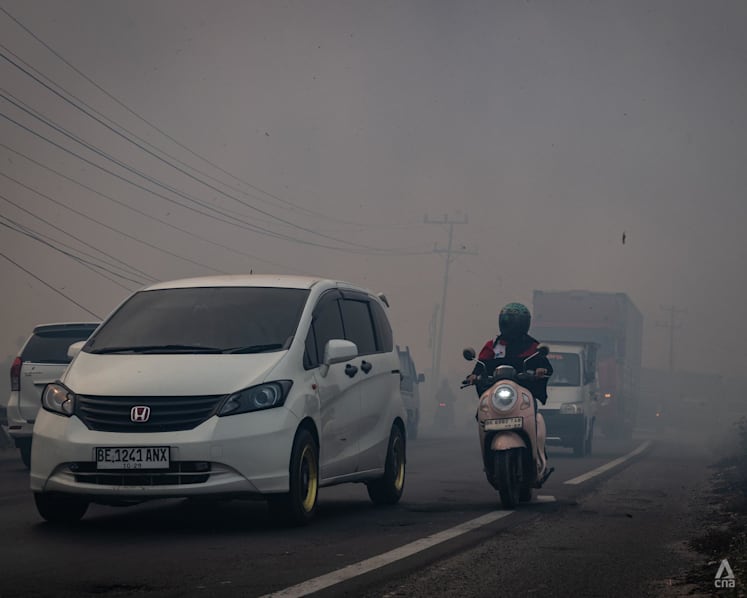 Motorists pass through a burning wildfire next to a major road in Ogan Ilir, South Sumatra, Indonesia on Sep 11, 2026. (Photo: CNA/Wisnu Agung Prasetyo)
The haze has taken a toll on people’s health, including Kholidi’s wife Emi, who is among the more than 110,000 Indonesians treated for wildfire-related respiratory illnesses so far this year.
“The haze sometimes got so bad it seeped through the doors and windows of our homes,” Kholidi said. Twice, he had to take Emi to a clinic for oxygen.
Worried about her health, he told her to stop working temporarily as a street sweeper, leaving him as the family’s sole breadwinner.
Indonesia’s forestry minister Raja Juli Antoni has cautioned that the worst is yet to come, with meaningful rainfall not expected until early October.
For workers like Kholidi, there is no easy escape. Staying home means earning nothing, while going out means risking their health with no guarantee of finding customers.
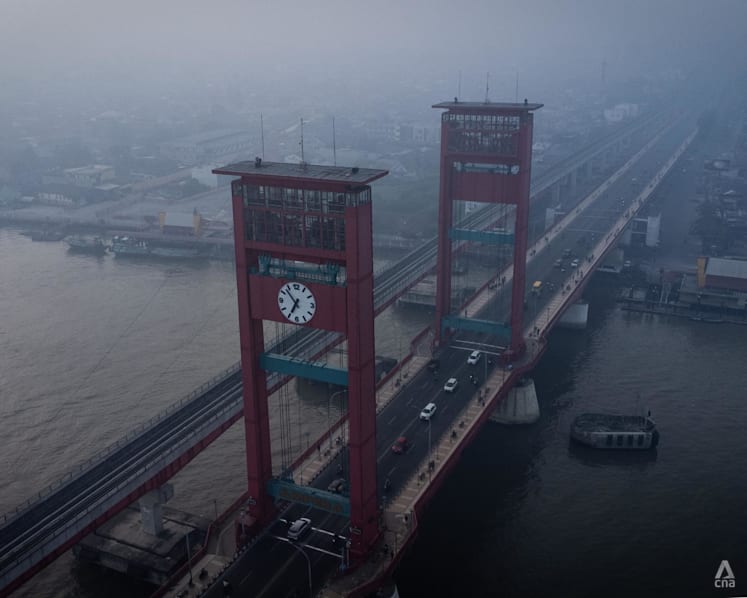 Haze from nearby wildfires blanketing the city of Palembang, Indonesia on Sep 13, 2026. (Photo: CNA/Wisnu Agung Prasetyo)
“Even when the skies appeared to clear, I could still feel the haze stinging my eyes and scratching my throat,” he said.
But with his wife unable to work and a teenage daughter still living at home, Kholidi has little choice but to keep pedalling.
CLOUDING LIVELIHOODS
Forest and land fires flare up in Indonesia almost every dry season, often linked to land clearing for agriculture and plantations. Dried-out peatlands can worsen the problem, allowing flames to spread underground and smoulder for weeks.
In Kalimantan, the Indonesian part of Borneo and home to around 17 million people, wildfires have reduced swathes of forest to ashes and killed protected wildlife.
But the toll has been particularly acute in Sumatra, which has about four times Kalimantan’s population. Crops, homes and public infrastructure have been damaged, disrupting the lives and livelihoods of millions.
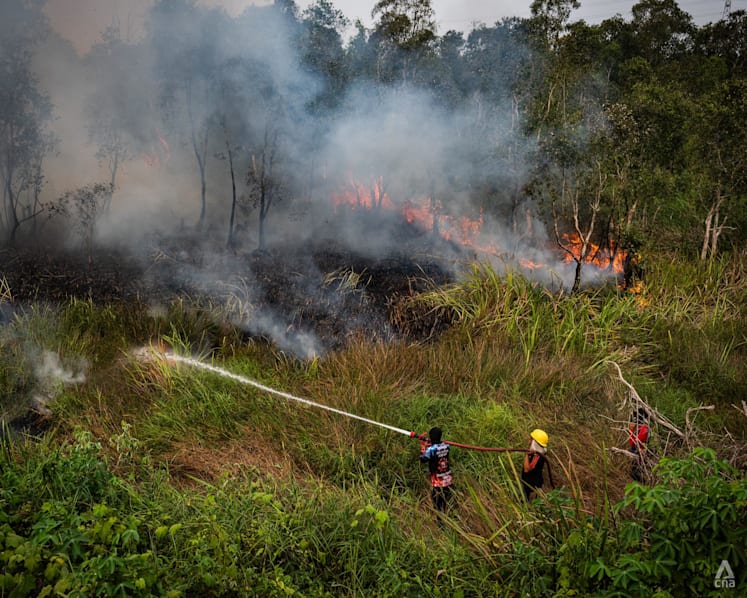 Firefighters fight a wildfire in Ogan Ilir, South Sumatra, Indonesia on Sep 11, 2026. (Photo: CNA/Wisnu Agung Prasetyo)
The haze has also disrupted education, forcing schools in affected areas to shift to remote learning.
As of Sep 2, more than 1.4 million students across six provinces were studying remotely, Reuters cited an education ministry official as saying.
The situation this year could cost the country as much as 123 trillion rupiah (US$6.9 billion) in economic and health losses, according to estimates from the Center for Economic and Law Studies (Celios), a Jakarta-based think-tank.
The night market around Palembang’s iconic Ampera vertical lift bridge has drawn fewer tourists since the haze began, said Oktarina Pertiwi, who sells souvenir T-shirts and nightgowns from a makeshift stall.
“On Friday nights and weekends, this market would be so full of people it’s difficult to move around. But for the past few weeks, it’s been really quiet,” the 35-year-old woman told CNA on Sep 11.
The stall normally grosses around 4 million rupiah per night, she said.
“Since the haze, we’re lucky if we get 1 million rupiah, maybe 1.5 million rupiah.”
On the other side of town, 32-year-old Derian Winata spends his afternoons selling drinks from the back of his minivan to joggers and sports enthusiasts at Palembang’s Jakabaring Sports Complex.
He typically earns around 400,000 rupiah on weekdays and 600,000 rupiah on weekends. Since the haze set in, his earnings have halved as fewer people exercise outdoors.
“It’s been a tough few weeks for me,” he told CNA.
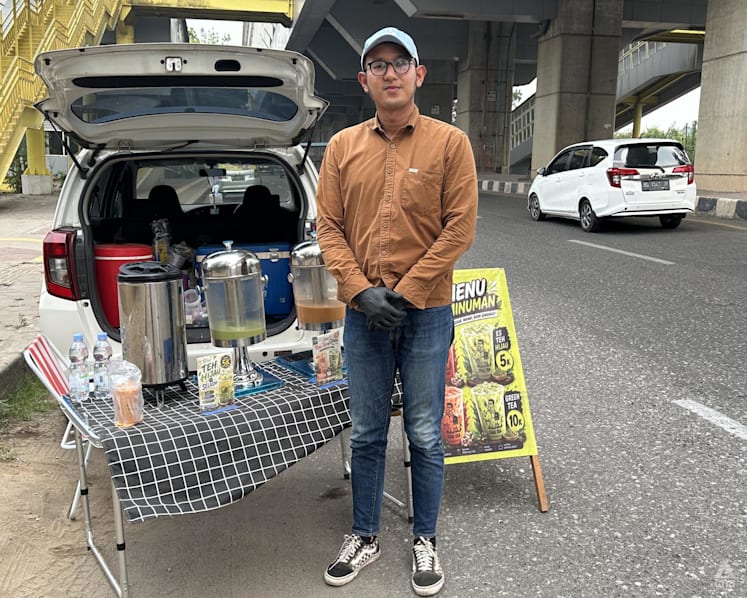 The Jakabaring Sports Complex in Palembang, South Sumatra where Derian Winata sells his drinks has been largely deserted because of the haze. (Photo: CNA/Nivell Rayda)
Even on days when the skies appear clearer, many of his regular customers are reluctant to return.
“People are still afraid,” he said, noting that Palembang’s air quality remains “very unhealthy”.
Derian believes customers will return once the rains come and the air clears.
“I do hope that happens soon,” he said.
But relief may still be some way off.
Scientists have predicted a prolonged dry season this year due to "super-El Nino" conditions, with the rainy season not expected to begin until around December in much of Indonesia.
CAN AID COME IN TIME?
Clothes vendor Oktarina has been praying for an end to the wildfires. Her parents live in a remote village near several reported hotspots.
“I’m really worried about them. The haze is much worse there than in the city,” the 35-year-old woman told CNA.
“But what can I do? I also need to work so I can send them money.”
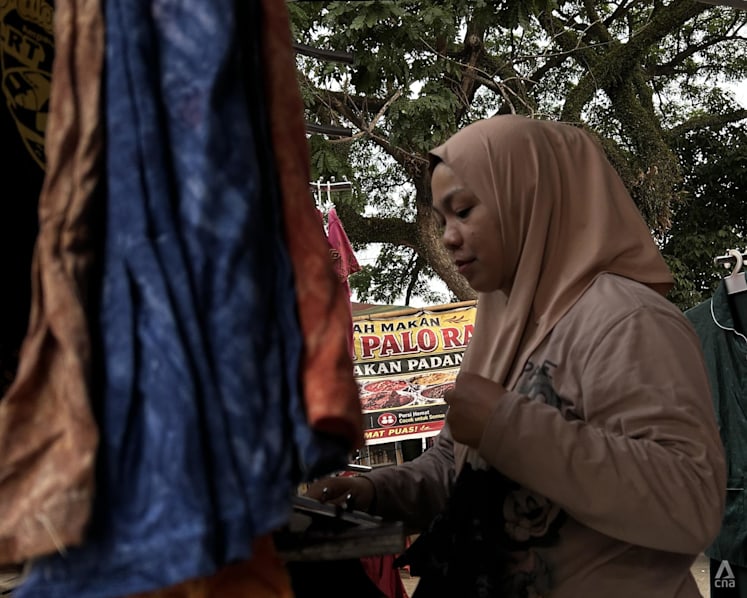 The night market where Oktarina Pertiwi sells her souvenir T-shirts has been quiet for weeks because of the haze in Palembang, South Sumatra, Indonesia. (Photo: CNA/Nivell Rayda)
With most air quality monitoring stations located in major cities and towns, pollution levels in more remote areas can be difficult to gauge.
Relief efforts, however, have been gathering pace.
Indonesia’s Health Ministry has instructed public hospitals and government-run clinics in affected areas to provide free oxygen and medical treatment to people suffering from haze-related illnesses.
It has also set up temporary medical posts to reach victims in more remote areas.
Meanwhile, the Ministry of Micro, Small and Medium Enterprises announced last month that it was earmarking more than 618 billion rupiah to assist more than 200,000 micro, small and medium enterprises (MSMEs) in disaster-affected areas.
“The central government will not leave provincial, regency or city governments to deal with this on their own,” MSME Minister Maman Abdurrahman said on Aug 26.
But Maman added that his ministry is still prioritising businesses impacted by last year’s floods and landslides in West Sumatra, North Sumatra and Aceh.
For businesses affected by recent disasters, including last month’s 7.7 magnitude earthquake in East Nusa Tenggara and the latest wildfires, the ministry has yet to determine who will qualify for the programme or when it will provide assistance.
“However, we assure you that we are fully committed to delivering (the aid),” he said.
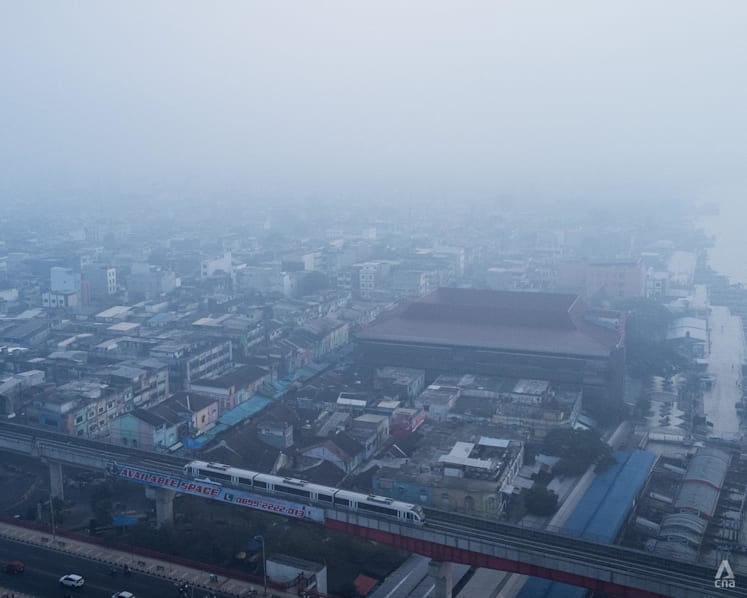 Haze blankets the city of Palembang in South Sumatra, Indonesia, on Sep 13, 2026. (Photo: CNA/Wisnu Agung Prasetyo)
In the meantime, businesses and workers in Sumatra are finding their own ways to make ends meet.
Drink seller Derian is looking for customers elsewhere, including near university campuses.
“But (these campuses) are seeing reduced activities too because students can opt to study remotely,” he said.
Rickshaw driver Kholidi has fewer options.
At 60, he said he can no longer pedal far from his home in southern Palembang, particularly along routes with hills and flyovers.
Instead, he spends longer hours on the streets, refusing to return home until he has earned enough.
“I can only wait and hope for the haze to end,” Kholidi said.
“Then everything can go back to normal.”








 English (US) ·