


 9 months ago
88
9 months ago
88
ADVERTISE HERE
 Abang Johari and other guests of honour pose for a photo at the launch of the Island-Class Fast Patrol Vessel and the inauguration of the Miri UKPS Headquarters on July 18, 2023. Photo: Ukas
Advertisement

By Marlynda Meraw
“Through the Sarawak Research and Development Council (SRDC), the Sarawak government facilitates and enables a vibrant and competitive research and development ecosystem in Sarawak by providing funds, coordinating and monitoring such activities, and eventually realising such ideas into viable products that benefit the Sarawak economy, create more jobs, and make us more competitive.” Abang Johari (November 2, 2022)
A stable society and a dynamic research and development (R&D) landscape are essential for sustained progress in any region. At the heart of both lies security, which not only ensures public safety but also underpins economic prosperity, safeguards critical infrastructure, and supports the overall well-being of the population. For Sarawak, a State celebrated for its expansive natural beauty, rich biodiversity, and diverse communities, a focused approach to both security and R&D is paramount as it navigates its unique challenges and strives to capitalise on future opportunities.
Advertisement

Sarawak Premier Datuk Patinggi Tan Sri Abang Johari Tun Openg has strongly prioritised both security and R&D as integral to Sarawak’s development agenda. Under his leadership, Sarawak has undertaken bold institutional reforms and forward-looking investments to ensure that enforcement capabilities and research infrastructure are fit for the demands of a modern, rapidly developing region. This commitment is best exemplified by the establishment and expansion of two key institutions: the Sarawak Security and Enforcement Unit (UKPS) and the Sarawak Research and Development Council (SRDC), each plays a vital role in ensuring that Sarawak remains both secure and progressive in the decades to come.
Sarawak Security and Enforcement Unit
Sarawak’s geographical position, coupled with its extensive coastline and marine biodiversity, presents both opportunity and responsibility. Recognising the strategic value of Sarawak’s coastal and riverine regions, Abang Johari initiated the restructuring of the former State Security Unit. Tasked with safeguarding Sarawak’s coastal and marine environments, UKPS operates under the Twelfth Malaysia Plan (12MP) and is managed by the Sarawak Public Works Department (JKR). It enforces State laws across rivers and coastal zones, curbing illegal trawling and strengthening surveillance across vital ecosystems.
 The Sarawak Coastguard demonstrating how an Interceptor boat is used to intercept a ‘foreign’ vessel during a demonstration on the Sarawak River along Kuching Waterfront.
UKPS is supported by the Sarawak Coastguard, with the latter officially launched in April 2021, playing a central role in protecting eight marine national parks: Similajau National Park, Tanjung Datu National Park, Talang Satang National Park, Miri-Sibuti Coral Reef National Park, Santubong National Park, Limbang Mangrove National Park, Bruit National Park, and Luconia Shoals National Park.
Beyond routine enforcement, UKPS supports critical functions such as search and rescue (SAR) operations, public safety, and inter-agency coordination. Since its restructuring, the unit has completed 27 patrol operations, 10 SAR missions, and two full-scale SAR exercises. To bolster capacity, the Sarawak government invested in a fleet of six island-class patrol vessels equipped with waterjet propulsion and digital tracking systems. These vessels were constructed by Slipways Sdn Bhd under a RM73.243 million contract administered by JKR. Delivered in two phases: three in November 2022 and three more in July 2023, they significantly enhance UKPS’s maritime reach. Additional fast patrol vessels are also being procured to further extend patrol capability across marine parks.
 Buckland (centre) looks on as JKR Sarawak deputy director Wisil Lichok (right) and UKPS director Dr Chai Khin Chung (left) shows the signed Instrument Handover documents after the signing ceremony. Photo credit: Ukas
On July 18, 2023, a Memorandum of Understanding (MoU) was signed between UKPS and the Sarawak Forestry Corporation (SFC), enabling UKPS officers and assets to be stationed at SFC sites to support enforcement duties. Two days later, on July 20, 2023, Abang Johari announced plans to build permanent UKPS bases in Sejingkat, Tanjung Manis, Bintulu, and Lawas—key strategic locations along Sarawak’s coast.
UKPS is also deeply involved in broader security dialogues. On September 9, 2024, UKPS and Sarawak Energy co-hosted the inaugural Critical Infrastructure Summit 2024. Gathering over 400 security professionals, the event focused on strengthening strategies to protect the State’s infrastructure and essential services from evolving threats.
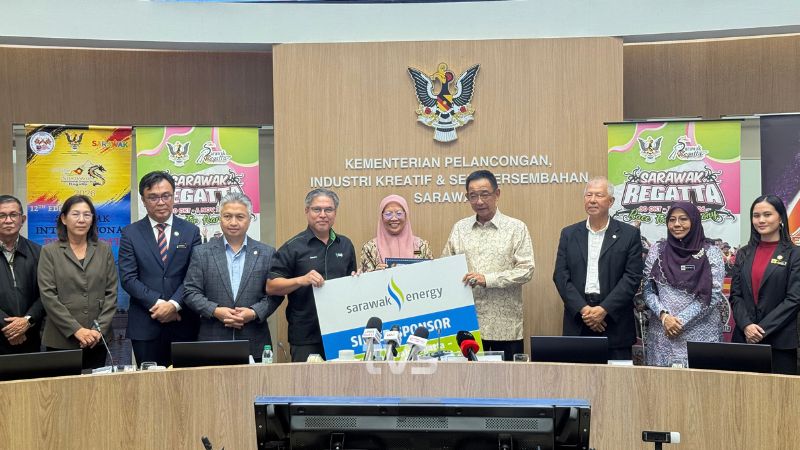
 Julaihi (standing back, center), Sharbini (standing back, second left) and others witness the MoU signing ceremony between Sarawak Energy and UKPS.
Sarawak Research and Development Council
Complementing Sarawak’s investment in physical and territorial security is an equally robust commitment to intellectual and scientific advancement. The Sarawak Research and Development Council (SRDC), established in 2017 under its own Ordinance, reflects the State’s vision of creating a knowledge-intensive economy driven by innovation, sustainability, and commercial potential. SRDC functions as Sarawak’s principal coordinating body for R&D activities.
It is mandated to direct, fund, and monitor research across public and private institutions, ensuring alignment with the State’s developmental goals. Its mission is to enhance research quality, fast-track commercialisation, and support Sarawak’s emergence as a regional science and technology hub.
Central to this effort is the cultivation of innovation at all levels. Initiatives such as the Bright Sparx Fund, offering up to RM5,000 for student-led projects, nurture creativity from a young age. From 2019 to 2024, SRDC funded 79 innovative projects with RM16.6 million. As of November 2024, 58 per cent of these projects have been completed, with the remaining projects still in progress.
SRDC’s expanding ecosystem includes partnerships with universities, private sector players, and global institutions. Key initiatives include the Research Performance Monitoring System (RPMON), which ensures transparency and accountability in research management.
The council has also established specialised infrastructure to support targeted scientific and industrial research, such as the Sarawak Biovalley Pilot Plant in Miri, the Sarawak Science Centre (SSC), and the Sarawak Infectious Disease Centre (SIDC).
Sarawak Science Centre
The SSC, a subsidiary of SRDC, and overseen by the Ministry of Education, Innovation, and Talent Development (MEITD), commenced construction in Q4 2023. It aims to collaborate with global science centres to realise its educational mission. In May 2024, a delegation led by the MEITD minister Dato Sri Roland Sagah Wee Inn, visited Hüttinger in Nuremberg, Germany, the appointed exhibit designer and fabricator for the project. Discussions covered finalising exhibit types, graphic designs, cost estimations, and the timeline for exhibit fabrication.
 Sagah (fourth left) in a group photo with others at the First Pile Ceremony of Sarawak Science Centre (SSC) project site at Jalan Stadium, Petra Jaya on July 21, 2023.
As of November 2024, the construction of SSC is 40 per cent complete and is expected to be finished by December 2025. Once operational, the centre will bring international science concepts into Sarawak’s classrooms and public engagement spaces.
Sarawak Infectious Disease Centre
Meanwhile, SIDC, which began construction in 2024, is expected to be completed by the end of 2026, adding much-needed research capacity in public health and virology. A major highlight in 2024 was the launch of SRDC’s thematic grant call focused on renewable energy, specifically hydrogen production and storage. As Abang Johari emphasised, reducing production costs is vital for Sarawak to lead in hydrogen innovation and global sustainability efforts. More targeted grant calls are planned for 2025 to further anchor the State’s role in the clean energy transition.
 An infographic illustrates the current physical progress of the Sarawak Infectious Disease Centre (SIDC). Photo credit: Sarawak Public Communication Unit (UKAS) livestream on YouTube.
Strategic Governance for Safer, Smarter Future
The establishment and evolution of UKPS and SRDC reflect Sarawak’s strategic approach to governance, where security and innovation advance together. While one ensures that the State’s people, environment, and infrastructure are protected, the other fuels long-term growth through science, knowledge, and technology.
This dual-focus strategy strengthens investor confidence, supports economic diversification, and builds resilience against a spectrum of emerging threats, whether environmental, digital, or economic. By prioritising both enforcement and R&D, Sarawak positions itself not just as a safe and stable region, but as a regional leader in innovation. Through the continued strengthening of UKPS and the expansion of SRDC’s research mandate, Sarawak is laying the groundwork for a secure, knowledge-driven future: one that is well-prepared for the challenges of today and the opportunities of tomorrow.
The content featured here is an excerpt from the book “Rise of Sarawak: Abang Johari’s Era of Transformation”, published by Sage Salute Sdn Bhd.




 English (US) ·