


 9 hours ago
9
9 hours ago
9
ADVERTISE HERE
The smoke crossing from Kalimantan has exposed a hard truth: Sarawak’s worst haze is no longer just an environmental issue, but a regional crisis demanding ASEAN action.
FOR weeks, the morning sky over southern Sarawak has carried the same unsettling signature: a grey horizon, the smell of smoke and air quality warnings replacing clear blue skies.
From school closures and respiratory illnesses to disrupted businesses and cloud-seeding missions, the 2026 transboundary haze has become one of Sarawak’s most severe environmental emergencies since 2019.
Yet despite the state’s rapid response, one reality has become increasingly evident — Sarawak cannot solve the haze on its own.
The reason lies across the border.
A crisis carried by the wind
Sarawak and Kalimantan share the same island of Borneo, separated politically but connected geographically. During the Southwest Monsoon, prevailing winds transport smoke from large forest and peatland fires in Indonesian Kalimantan directly into Sarawak.
Unlike floods or local pollution, transboundary haze originates beyond the state’s jurisdiction. Sarawak has neither the legal authority nor operational control to extinguish fires occurring inside another sovereign nation.
That geographical reality explains why local interventions, including cloud seeding, health advisories and disaster preparedness, can reduce impacts but cannot eliminate the source of the smoke.
The 2026 haze illustrates that limitation.
Air quality began deteriorating sharply in mid-August as smoke drifted into Sarawak. By Aug 20, more than 500 schools across several districts were ordered to close after Air Pollutant Index (API) readings reached unhealthy levels.
The situation worsened further in early September when Serian and parts of Kuching entered the “very unhealthy” and “hazardous” categories, prompting emergency responses including the state’s third cloud-seeding operation.
Even after multiple days of cloud seeding, persistent dry weather and continuing fires in Kalimantan kept haze lingering across parts of the state into late September.
When haze becomes a health emergency
The most immediate victims of transboundary haze are people.
Fine particulate matter, commonly known as PM2.5, penetrates deep into the lungs and bloodstream. Health authorities have consistently warned that prolonged exposure increases the risk of asthma attacks, breathing difficulties, eye irritation and cardiovascular complications.
Children, older persons and individuals with existing respiratory diseases face the greatest danger.
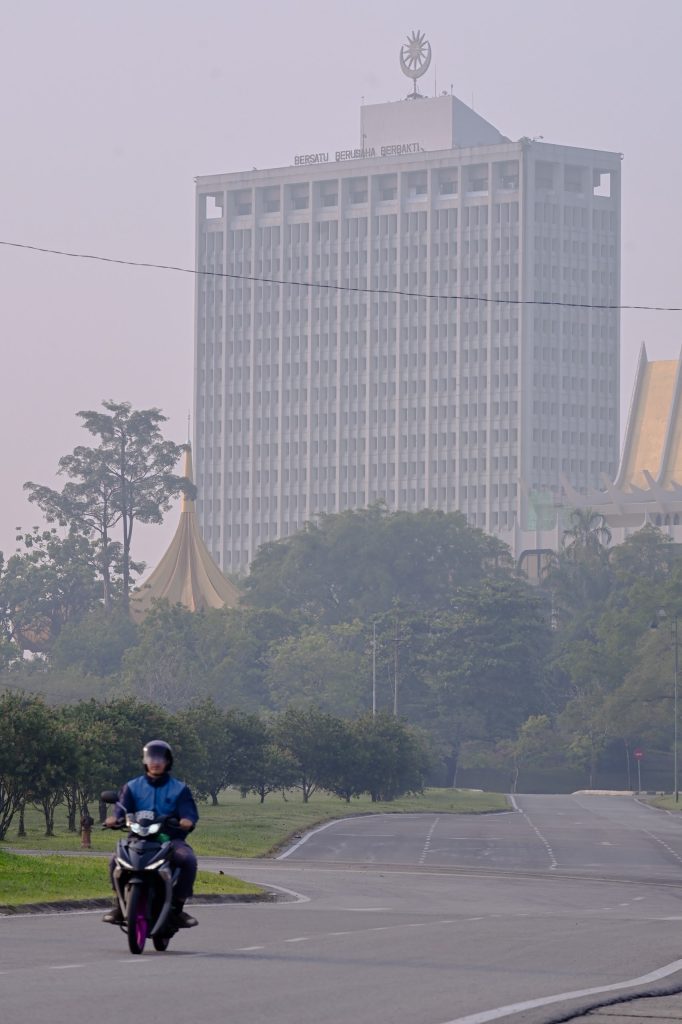 A motorcyclist rides through the hazy condition in Kuching. Photo: Mohd Alif Noni
As API levels entered hazardous territory in some districts, hospitals and clinics prepared for increased respiratory cases while the public was advised to remain indoors, wear protective masks and minimise outdoor activities.
Unlike visible smoke, PM2.5 cannot be easily detected by the naked eye, making it one of haze’s most dangerous pollutants.
The public health burden extends beyond immediate illness. Medical experts have long cautioned that repeated exposure to severe haze episodes can contribute to chronic respiratory and heart diseases, placing additional pressure on healthcare systems.
Malaysian Medical Association (MMA) said prolonged exposure to fine particulate matter in haze could worsen asthma and existing heart and lung conditions, while increasing the risk of respiratory infections and other health complications.
“Children, older persons, pregnant women and those with existing heart or lung conditions are particularly vulnerable and should take extra precautions,” its president Dr Sivanaesan Letchumanan said.
The invisible classroom casualty
Education has emerged as another major casualty.
When more than 500 schools closed in August, thousands of students lost valuable teaching days at a crucial point in the academic calendar.
Even schools that remained open suspended outdoor assemblies, sports and co-curricular activities whenever API readings exceeded safety thresholds.
For examination-year students, repeated interruptions create learning gaps that cannot easily be recovered through compressed schedules.
Teachers have also been forced to adapt lessons while balancing student safety, highlighting how climate-related disasters increasingly affect education systems beyond traditional floods or storms.
A costly economic slowdown
Haze rarely appears in economic reports as a single statistic, but its consequences ripple across nearly every sector.
Tourism is among the first industries affected as poor visibility discourages visitors from travelling to national parks, cultural attractions and outdoor destinations.
Construction projects experience slower productivity because outdoor work must be reduced during unhealthy air conditions.
Delivery riders, farmers, road maintenance crews and other outdoor workers face longer exposure to polluted air, reducing efficiency while increasing health risks.
Small businesses suffer too.
Restaurants, cafés and retail outlets often experience lower customer traffic as families choose to stay indoors. Outdoor markets and recreational activities also record declining attendance during prolonged haze episodes.
The overall economic cost extends far beyond immediate revenue losses, encompassing healthcare expenditure, reduced labour productivity and disruption to public services.
Burning peat, losing Borneo
Behind the smoke lies another environmental tragedy.
Many fires in Kalimantan occur on peatlands — carbon-rich wetlands that store enormous quantities of organic material accumulated over thousands of years.
Once ignited, peat burns underground for weeks or even months, making fires extremely difficult to extinguish. They release vast amounts of carbon dioxide while destroying habitats for endangered wildlife across Borneo’s interconnected ecosystems.
The ecological consequences do not recognise borders either.
Wildlife corridors, river systems and forest ecosystems stretch across both Sarawak and Kalimantan, meaning environmental degradation in one region inevitably affects the other.
Climate scientists regard peatland protection as one of Southeast Asia’s most important natural climate solutions because preventing peat fires avoids both biodiversity loss and massive greenhouse gas emissions.
Abang Johari’s ASEAN challenge
Premier Datuk Patinggi Tan Sri Abang Johari Tun Openg believes the solution must become regional rather than purely national.
Speaking during a fireside chat at Gastech 2026 in Bangkok, moderated by Channel NewsAsia (CNA) business news presenter Roland Lim on Sept 14, he urged the ASEAN Secretariat to lead the development of a practical mechanism for combating large-scale forest fires across Southeast Asia.
Recalling Sarawak’s devastating haze episodes from two decades ago and their recurrence today, he said long-term solutions require cooperation between governments rather than isolated emergency responses.
 Abang Johari responding to questions from CAN during the fireside chat session in Bangkok.
Among his proposals is the establishment of specialised ASEAN firefighting assets, including amphibious aircraft capable of scooping water from rivers and reservoirs for rapid aerial water bombing, similar to systems used in Canada.
His argument is straightforward: forest fires may begin within one country’s borders, but transboundary haze quickly becomes everyone’s problem.
He also stressed that stronger peatland management, environmental protection and carbon mitigation remain essential responsibilities for individual countries alongside regional cooperation.
ASEAN’s test of cooperation
Sarawak’s appeal coincides with a significant diplomatic development.
On Sept 19, BERNAMA reported that Indonesia accepted Malaysia’s offer to assist in combating forest and land fires in Kalimantan after discussions between Deputy Prime Minister Datuk Seri Ahmad Zahid Hamidi and Indonesian President Prabowo Subianto.
The proposed assistance includes deployment of a Bombardier CL-415MP amphibious aircraft, three helicopters and 52 personnel from the National Disaster Management Agency (Nadma), Malaysian Maritime Enforcement Agency and Royal Malaysian Air Force.
The acceptance marks an important breakthrough because cross-border disaster response depends on the consent of the affected country.
However, as of late September, Malaysia’s firefighting assets have yet to be fully deployed on the ground, underscoring the logistical and diplomatic complexity of international disaster operations.
The episode demonstrates both the strengths and limitations of ASEAN cooperation: political goodwill exists, but rapid operational mechanisms still require improvement.
Can Malaysia take legal action?
Beyond diplomacy lies another question: could Malaysia pursue legal remedies?
Universiti Kebangsaan Malaysia law associate professor Dr Shahrul Mizan Ismail, in his opinion published by Malay Mail on September 19, argues that Malaysia already possesses legal instruments under the ASEAN Agreement on Transboundary Haze Pollution.
His analysis suggests that smoke drifting into Sarawak and the region’s highest haze alert provide sufficient grounds to investigate possible breaches of treaty obligations concerning prevention, information sharing and emergency response.
However, he cautions that cross-border smoke alone does not automatically establish Indonesia’s legal liability.
Instead, the legal focus should examine whether authorities exercised adequate due diligence through effective regulation, enforcement and supervision of fire risks.
He proposes a four-step strategy: issue a substantiated notice of claim, assemble independent scientific evidence linking fires to Malaysian exposure, quantify health and economic losses, and pursue a binding dispute mechanism such as arbitration or a bilateral claims commission.
Crucially, he also argues that any Malaysian companies found contributing to fires should face equal investigation, ensuring accountability is based on evidence rather than nationality.
In essence, his message is clear: Malaysia already has the legal tools to act; what is needed now is a disciplined, evidence-based strategy instead of relying on diplomacy alone.
Beyond cloud seeding
Sarawak’s cloud-seeding operations offered temporary relief, but they also highlighted the limits of weather modification.
Rain can suppress airborne particles and replenish shrinking reservoirs, yet it cannot extinguish extensive peat fires burning hundreds of kilometres away.
Long-term success depends on preventing fires before they spread.
That means sharing satellite hotspot data in real time, investing jointly in early-warning systems, strengthening enforcement against illegal open burning, restoring degraded peatlands and educating communities in fire-prone areas about sustainable land clearing.
MMA believed that continued regional cooperation is needed to address the causes of transboundary haze.
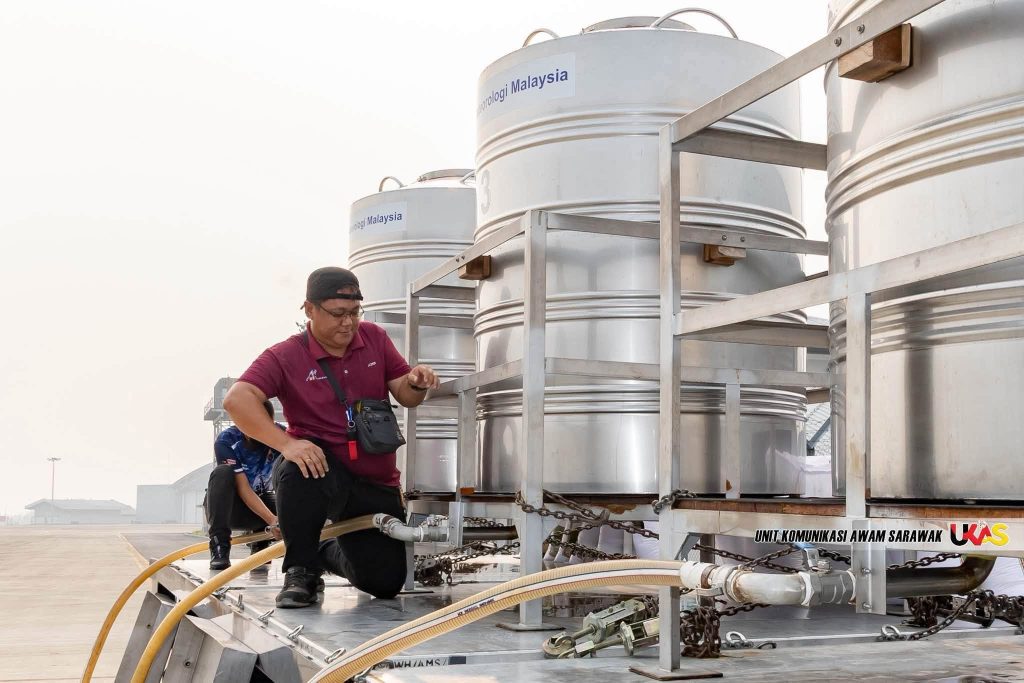 Preparation for the cloud seeding exercise. Photo: UKAS
“Malaysians should not have to face the same health threat year after year. Protecting public health must remain a priority while longer-term solutions to the haze are pursued,” Dr Sivanaesan said.
For Sarawak, the lesson of 2026 is unmistakable.
The haze may enter through its skies, but its origins, consequences and solutions extend far beyond its borders. On an island shared with Kalimantan and within a region bound together by ASEAN, clean air has become a collective responsibility.
Until that responsibility is matched by equally coordinated action, Sarawak will remain vulnerable to a crisis carried not by politics, but by the wind.






 English (US) ·