


 1 hour ago
5
1 hour ago
5
ADVERTISE HERE
KUCHING, 5 Oct: Artificial intelligence (AI) is no longer confined to applications on Earth, with the technology already being used to manage the increasingly crowded environment around the planet, according to former Japanese astronaut Dr Soichi Noguchi.
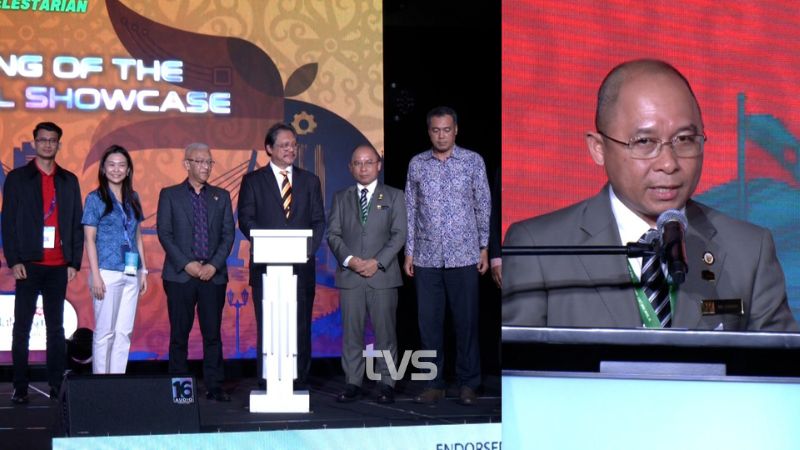
Noguchi, delivering a presentation at the International Digital Economy Conference Sarawak (IDECS) 2026 in the presence of Sarawak Premier Datuk Patinggi Tan Sri Abang Johari Tun Openg, said the rapid growth of satellite networks had created a need for more sophisticated space traffic management.
He said large satellite networks require millions of observations to keep track of surrounding objects and movements, making manual processing increasingly impractical.
“So that has to be processed. How do you do that? Of course, AI. We use AI power on the ground,” he said.
Noguchi compared the increasingly congested orbital environment to a familiar problem on the ground.
“It’s a traffic jam, just like what happened in Kuching this morning,” he added.
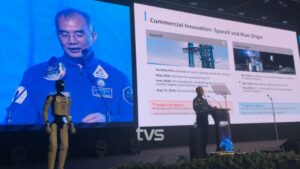 Former Japanese astronaut Dr Soichi Noguchi delivers a presentation on commercial space innovation, including developments involving SpaceX and Blue Origin, at IDECS 2026 in Kuching.
He said AI is becoming part of a wider space traffic control system, allowing operators to process large volumes of observations and monitor the movement of satellites around Earth.
The growing convergence between artificial intelligence and space technology, he added, is also changing the scale of data being generated and transmitted by future satellite systems.
Noguchi noted that next-generation satellite networks are expected to handle data at terabit levels, rather than the megabit or gigabit capacities commonly associated with earlier systems.
The development is particularly relevant as Sarawak moves towards its own nanosatellite programme.
Noguchi expressed hope that the state’s planned nanosatellite initiative by 2030 would benefit from continuing advances in the global space industry.
“Hopefully your program, making a new nanosat by 2030, will also benefit from those advances,” he said.
He further said the increasingly close relationship between AI, satellite technology and people on the ground could open a new phase in the development of the space economy.
“Space and AI are shaking hands in space,” he said. – TVS
 English (US) ·