


 10 months ago
187
10 months ago
187
ADVERTISE HERE

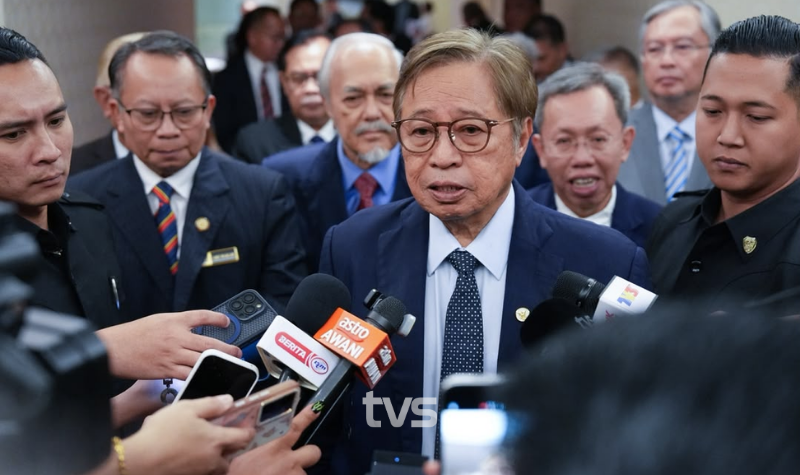
While acknowledging the government’s fiscal discipline, Lau highlights Malaysia’s pressing economic vulnerabilities — particularly rising debt and potential sovereignty risks linked to a key US trade agreement. – Bernama photo
SIBU (Dec 5): Against the backdrop of a ‘safe’ budget and ongoing fiscal reforms, Senator Robert Lau has underscored a stark reality in Malaysia’s path toward long-term economic resilience.
While acknowledging the government’s fiscal discipline, he highlighted Malaysia’s pressing economic vulnerabilities — particularly rising debt and potential sovereignty risks linked to a key United States (US) trade agreement.
He commended efforts to strengthen accountability through the Public Finance and Fiscal Responsibility Act 2023 and the new Government Procurement Act, describing them as essential as Malaysia navigates fiscal constraints, geopolitical risks, and structural weaknesses.
“We must strengthen accountability, modernise our economy, invest wisely, and negotiate confidently.
“Only then can we build a resilient and dignified Malaysia for all,” he said in a statement.
Lau cited the fiscal deficit as Malaysia’s greatest long-term vulnerability, noting that it forces the country to borrow more each year and weakens its financial resilience.
He said federal government debt reached RM1.247 trillion in 2024 — a 6.4 per cent increase from 2023, lower than the previous 8.6 per cent rise.
“For 2026, new borrowing will be RM74.8 billion – an amount that is RM74.8 billion too much, but unavoidable under current conditions,” he said.
At the current pace, Lau warned that achieving a balanced budget could take a decade or longer, with national debt continuing its upward trend.
A key concern is the debt-servicing ratio, which has climbed to 16.3 per cent (RM58.3 billion) — nearly equivalent to the total Sales and Service Tax (SST) collection of RM58.6 billion.
“This is up from 14 per cent in 2022, and will likely continue rising unless revenue grows faster than expenditure,” he said.
Lau described the Supply Bill 2026 — the fourth Madani government budget — as a “safe and within-the-norm” budget: not overly exciting, yet not disappointing.
The bill delivers higher revenue, mainly from SST, alongside a reduced fiscal deficit and lower absolute debt growth.
On subsidy reforms, he noted that the RON95 rationalisation has finally taken effect, yielding savings “primarily through the plugging of leakages to foreigners”.
“Malaysia’s economy grew 4.4 per cent in the first half of 2025, and is expected to end the year between 4.0 per cent and 4.8 per cent.
“As long as we continue to grow, the deficit remains manageable,” Lau said.
The deficit has been reduced for five consecutive years: 5.6 per cent (2022), 5.0 per cent (2023), 4.1 per cent (2024), 3.8 per cent (2025 estimated), and 3.5 per cent (2026 forecast).
Lau also pointed to growing uncertainty stemming from US trade policy shifts and geopolitical tensions.
He raised particular concerns regarding the Agreement on Reciprocal Trade (ART) with the US.
While the agreement provides certainty, it also raises questions about its implications for Malaysia’s policy autonomy.
Malaysia currently enjoys a goods trade surplus of around US$20 billion with the US. However, the ART requires Malaysia to reduce tariffs on US goods to zero and open its markets, while many Malaysian products continue to face US tariffs of up to 19 per cent — though 1,700 items are exempted.
More concerning, Lau said, are restrictive clauses under Article 5.1, which require Malaysia to align with US trade measures against third countries based on US-defined “economic or national security concerns”.
Article 5.2 obliges Malaysia to cooperate with US export controls — including unilateral restrictions — and take domestic action against companies owned or controlled by third countries.
Under Article 5.3, if Malaysia signs a trade agreement with another nation deemed harmful to US interests, the US may terminate the ART and reinstate tariffs.
Lau noted that these clauses — widely seen as targeting China, Malaysia’s second-largest trading partner — have already raised questions like: “Can these clauses be refined before implementation? How are we going to thread between the two competing giants?”



 English (US) ·