
 1 hour ago
7
1 hour ago
7
ADVERTISE HERE
A few weeks ago, I wrote about the man who runs Sarawak. This time, it is about the three who sit beside him. Sit through enough official functions here and you notice the chairs. Everybody knows the first one. The cameras find it before the event starts, and the emcee says the name slowly. Then there is the second chair, sometimes on the left, sometimes on the right, always half a step back. Sarawak has three of those chairs: Datuk Amar Awang Tengah Ali Hasan, Datuk Amar Douglas Uggah Embas and Datuk Amar Dr Sim Kui Hian. I have met two of them across a long career, and never in the way you would expect.
The first was Awang Tengah, a long time ago. I was with a broadcasting agency then, sent up to Lawas for a function in his kawasan. Lawas in those days was a long way from anywhere, and it still is. I remember the heat, the cables, the scramble of a crew on location. I did not understand it then. I do now. He is still there, and has held that ground since long before many Sarawakians were born. There are people here with grandchildren who were not yet around when he first took his seat.
He now carries trade, industry and investment, plus natural resources and urban development. But the work I would point to is the one nobody photographs: the Native Customary Rights land measurement that has put an enormous stretch of this state onto a map. NCR land is not a ribbon-cutting. It is claims, hearings, families, memories and years of waiting. He is also still building that northern edge: the new Lawas airport, the coastal highway, the trade lines into Kalimantan and Brunei. Still working that edge, and that is not a career.
The second I have yet to meet, only because no assignment has put us in the same room. Douglas Uggah I know the way most Sarawakians know him: from a distance, through his updates, year after year. Infrastructure. Finance. And the chairmanship nobody envies, disaster management, a job with no season and no office hours. When the water rises at night, somebody has to be awake and deciding. That is the thing about following a man from a distance. The work speaks anyway.
An unbroken run of clean certificates from the Auditor-General, year after year. Fiscal discipline is the least photogenic achievement in government, and somebody made that happen. It was not an accident. Following the news is part of my work, so is watching how a story travels once it leaves the press release. One angle is never the whole picture. Somewhere in that watching, without ever working an event with him, I came to understand what Uggah stands for. Not many ministers can be known that way.
The third was Dr Sim, and there was nothing official about it. I was at dinner at a Japanese restaurant in Kuching. He was there with his family, doing what he always does: greeting people. Not the practised handshake you learn to spot at functions, just a man saying hello, with a warmth everyone in this city knows. Nobody was filming. He came to politics from a cardiac ward, the first head of cardiology at Sarawak General Hospital, and is still a consultant at the Heart Centre. The same hands that once threaded a catheter into a failing artery now sign off on drainage, rubbish collection and clinic postings. He does not seem to find that strange. It is the same care, only reaching further.
Look at the three of them on paper and it reads like three separate portfolios: different mandates, communities, temperaments. Silos, if you want the word. It isn’t. A road is not a road; it is a rural clinic a mother can reach the same morning instead of after a day on the river. A clean audit is not accounting; it is the standing that lets Sarawak borrow sensibly enough to build that road. Surveyed land is not paperwork; it is a family standing on ground that finally carries their name. Pull any thread here and you find it tied to the other two. None of them will tell you what it costs. But you can do the sums.
Weekends that belong to somebody else’s constituency. Flights to Limbang, Betong, Bintulu, then back for an early morning meeting. Birthdays attended by telephone. Men who could reasonably be home with their families, still opening things, still sitting through the same speeches, still saying yes. Much of that work is remarkably easy not to notice.
That is partly the nature of government. Things that work rarely announce themselves. A road opens and becomes the road you take. A flood is managed and people remember the water, not the decisions made at two in the morning. A piece of land is surveyed and years of claims and hearings disappear behind a line on a map.
Which is why all three need someone good behind them, but not a publicist. A communications officer makes sure this kind of effort does not go unnoticed, because when it does, the loss is not theirs. It is ours. People who cannot see what the government is doing will assume it is doing nothing, an assumption hard to reverse once it settles in. That is what strategic communications is for: translation, not publicity.
Knowing that a land survey figure means nothing until you say it is somebody’s grandfather’s land, finally on a map. Knowing that a road in Lawas is a story about a mother reaching a clinic, not tonnes of asphalt. Knowing that a clean audit is not a certificate filed away, but the confidence that public money is watched closely enough to build the next thing. And knowing that all of it carries one message these three would probably never say about themselves: that everything they are doing, in ministries that look nothing alike, is for the betterment of Sarawak.
The rest is media relations, simpler than people think. Be reachable. Answer the hard question instead of hiding from it. Know which reporter covers infrastructure and treat them as professionals, because that is exactly what they are. None of this requires turning the men in the second chair into the men in the first. That would miss the point. They are not going to ask for credit. That is exactly why the people behind them have to be very good at their jobs, and why the rest of us can simply notice.
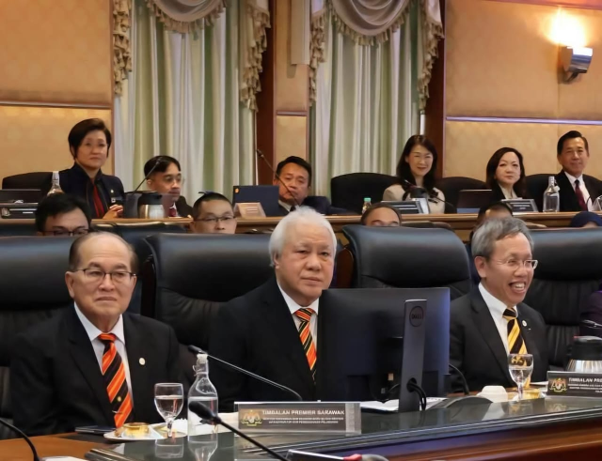 From left: Uggah, Awg Tengah, Dr Sim. Photo: UKAS
The views expressed here are those of the writer and do not necessarily represent the views of Sarawak Tribune.


 English (US) ·